- Author: Raymond
- Category: Expat Insurance in Kenya
Medical Evacuation and Repatriation Insurance Kenya
Learn how medical evacuation and repatriation insurance works for travellers and expatriates in Kenya, what it covers and when emergency transport may be required.
A serious illness or accident away from home can become more complicated when the nearest hospital cannot provide the treatment required.
Medical evacuation and repatriation insurance helps eligible travellers and expatriates meet the potentially significant cost of medically necessary transport when appropriate treatment is unavailable locally or when medically approved repatriation becomes necessary.
This can be particularly relevant for international travellers, expatriates, safari visitors, remote workers, international students and corporate employees travelling or working away from their normal home location.
WHO describes medical evacuation as a coordinated process involving clinical care, logistics, safe patient movement and appropriate medical decision-making. (Iris)
What Is Medical Evacuation?
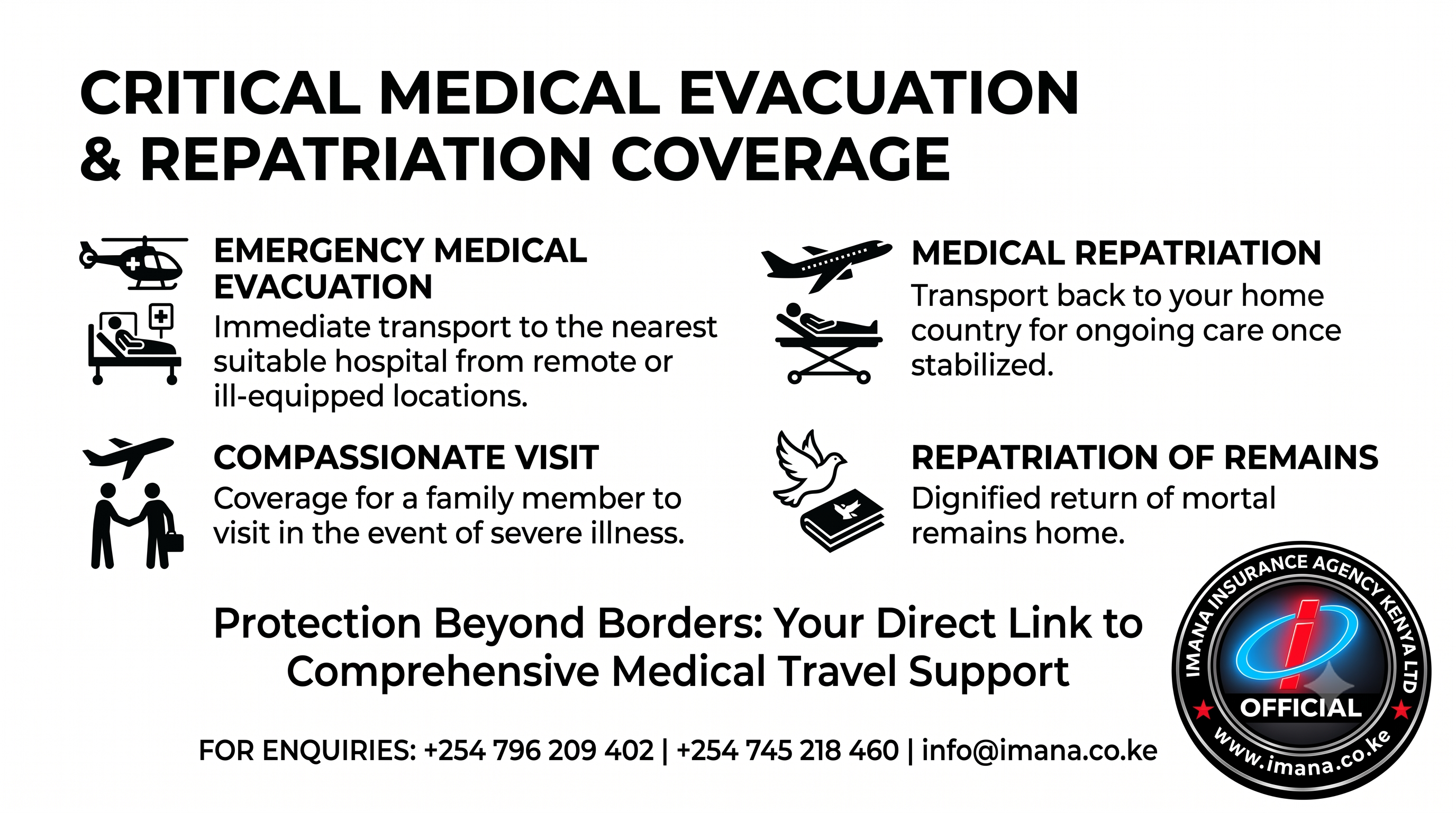
Medical evacuation—or medevac—involves medically necessary transportation from the patient's current location to an appropriate medical facility.
Transport could potentially involve:
- Ground ambulance
- Air ambulance
- Commercial flight with medical support
- Other medically appropriate transport
The choice is based on the patient's condition and available healthcare—not convenience. International medical-insurance documentation similarly describes evacuation using air ambulance, commercial flights or vehicles to an appropriate medical centre.
What Is Medical Repatriation?
Medical repatriation involves returning an eligible patient toward their home country or another location defined under the policy for continued medical treatment.
It differs from evacuation.
Evacuation
Current location → nearest or appropriate medical facility
Repatriation
Current treatment location → home country or covered home location
International insurers describe repatriation as returning expatriates home for treatment when appropriate under the policy.
Why Is Evacuation Cover Important?
The nearest clinic may be capable of treating minor illness but not:
- Complex surgery
- Major trauma
- Specialist cardiac care
- Advanced intensive care
- Certain neurological conditions
- Specialist paediatric cases
When suitable treatment cannot be provided locally, transportation itself can become part of the medical emergency.
International insurers therefore often include evacuation and repatriation within broader travel or international health plans.
Who Should Consider Medical Evacuation Cover?
It can be relevant for:
- International travellers
- Expatriates
- Safari travellers
- Business executives
- Students abroad
- International employees
- People travelling to remote destinations
- Families living overseas
- NGOs
- Corporate organisations
- Diplomats
- Frequent international travellers
How Does Medical Evacuation Work?
A typical process may involve:
1. Medical emergency occurs
The traveller receives initial treatment at the nearest suitable facility.
2. Assistance provider is notified
The insurer's emergency-assistance team reviews the case.
3. Medical information is assessed
Doctors may communicate with the treating facility.
4. Need for evacuation is determined
This is generally a medical decision, not simply a traveller preference.
5. Appropriate destination is identified
The patient may be transferred to a facility capable of providing suitable treatment.
6. Transport is coordinated
Depending on the clinical situation, this could involve road ambulance, commercial aircraft or specialist air ambulance. (allianzcare.com)
7. Treatment continues
The insurer and medical provider manage the case according to the applicable policy.
Does Medical Evacuation Mean an Air Ambulance?
Not always.
The words medical evacuation and air ambulance should not be treated as synonyms.
An evacuation could use:
- Ground ambulance
- Scheduled commercial flight
- Commercial flight accompanied by medical personnel
- Dedicated air ambulance
The medical team determines the appropriate method based on factors such as:
- Patient stability
- Distance
- Urgency
- Medical equipment required
- Availability of appropriate treatment
Can I Choose Which Country I Am Evacuated To?
Not necessarily.
Insurance usually provides transportation to an appropriate medical facility, not automatic transport to whichever country or hospital the insured member prefers.
Medical necessity, available treatment, distance, policy wording and assistance-provider approval usually determine the destination.
Medical Evacuation vs Repatriation of Remains
These are different benefits.
Medical evacuation: transports a living patient for necessary medical treatment.
Medical repatriation: returns a living patient to the covered home location for continued treatment when appropriate.
Repatriation of remains: involves arrangements following death abroad and may be a separate policy benefit.
Always check the policy schedule because each benefit can have different limits and procedures.
Does Travel Insurance Include Medical Evacuation?
Many international travel-insurance products may include evacuation or repatriation benefits, but limits and triggers vary.
WHO advises travellers to obtain appropriate insurance and specifically notes the importance of medical protection abroad, including repatriation considerations. (World Health Organization)
Before travelling, confirm:
- Evacuation limit
- Repatriation limit
- Territorial coverage
- Emergency telephone number
- Pre-authorisation requirements
- Pre-existing-condition exclusions
Does International Medical Insurance Include Evacuation?
Many international health plans include or offer evacuation and repatriation benefits alongside ongoing healthcare, though product terms differ.
This can be especially relevant for expatriates who regularly live or work outside their home countries.
Medical Evacuation for Kenya Safaris
A safari can involve travel far from major urban hospitals.
Travellers visiting areas such as:
- Maasai Mara
- Samburu
- Tsavo
- Amboseli
- Northern Kenya
- Remote conservancies
should establish beforehand:
- What medical facilities are nearby
- Emergency numbers
- Whether evacuation is insured
- Where the policy could transport them
- What activities are excluded
The goal is preparation—not fear.
Medical Evacuation for Corporate Employees
Organisations sending employees on international assignments should consider what happens if an employee becomes seriously ill or injured abroad.
Group medical repatriation products are designed around this type of employee mobility and can coordinate transport back toward the employee's home country when the policy conditions are met.
This may be particularly relevant to:
- Construction companies
- NGOs
- Regional businesses
- Engineering firms
- Consulting companies
- Logistics businesses
- International organisations
What May Be Excluded?
Depending on the policy, exclusions or restrictions may involve:
- Undeclared pre-existing conditions
- Travelling against medical advice
- Planned treatment abroad
- Treatment not considered medically necessary
- Unauthorised evacuation
- Excluded destinations
- High-risk activities not covered
- Treatment outside the insured geographical area
- Events occurring before the policy began
Always check the actual policy wording.
Never Arrange a Major Evacuation Without Contacting the Insurer
Unless the situation makes prior contact impossible, contact the insurer's emergency-assistance provider before independently booking expensive medical transportation.
The assistance team typically needs to:
- Review the medical condition
- Speak with treating doctors
- Determine medical necessity
- Choose an appropriate receiving hospital
- Coordinate transport
- Arrange guarantees of payment where applicable
WHO's medevac framework likewise emphasises coordination between clinical and operational teams.
Medical Evacuation Insurance Checklist
Before travelling or relocating, confirm:
- Emergency medical cover
- Medical evacuation benefit
- Repatriation benefit
- Repatriation-of-remains benefit
- Geographical area
- Destination exclusions
- Medical benefit limit
- Pre-existing-condition terms
- Emergency-assistance number
- Pre-authorisation process
- Nearest suitable hospitals
- Family members included
- Planned activities covered
- Policy dates cover the whole journey
Information Needed for a Quote
Imana may require:
- Traveller names
- Ages
- Destination
- Country of residence
- Departure date
- Return date
- Purpose of travel
- Medical history where relevant
- Existing insurance
- Required geographical area
- Number of travellers
For expatriate or annual medical cover, additional underwriting information may be required.
Frequently Asked Questions
Is medical evacuation the same as an ambulance?
No. Medical evacuation is the broader medically coordinated transfer process; an ambulance or aircraft can be one component of it. (World Health Organization)
Does medical evacuation always use an aircraft?
No. Appropriate transport may include ground ambulance, commercial aircraft or dedicated air ambulance.
Will I automatically be evacuated back to Kenya?
No. That depends on medical necessity and the policy. Evacuation may first take you to the nearest appropriate medical facility.
What is medical repatriation?
It is the medically appropriate transfer of an insured patient toward their covered home country or location for continued care.
Does international medical insurance include it?
Some international health plans include evacuation and repatriation, while others offer different benefit structures.
Should I arrange my own air ambulance?
Normally contact the insurer's assistance provider first unless circumstances make that impossible.
Get Medical Evacuation and Repatriation Cover Through Imana
Before travelling or relocating, ask one important question:
If appropriate medical care is not available where I am, how will I get to where it is?
Imana Insurance Agency Kenya Ltd can help compare travel and international medical insurance options that include appropriate emergency medical benefits.
Visit:
Imana Insurance Agency Kenya Ltd
Imana Travel Insurance
Plan the Journey with MyKava
MyKava Travel & Insurance can assist with:
- International and domestic flights
- Hotel accommodation
- Airport transfers
- Kenya safaris
- Group travel
- Corporate travel arrangements
Visit MyKava Travel & Insurance.
Plan with MyKava. Protect with Imana.
MyKava Travel & Insurance helps organise the journey.
Imana Insurance Agency Kenya Ltd helps you compare insurance protection for the risks that may come with it.
Flights. Hotels. Transfers. Safaris. Travel insurance. International medical insurance. One connected travel experience.
Benefits, geographical limits, medical necessity criteria, underwriting, evacuation procedures and exclusions differ among insurers. This content is general information and does not replace an issued insurance policy.
Author: Prepared by Imana Insurance Agency Kenya Ltd in collaboration with MyKava Travel & Insurance.
Date published: 9 August 2026