- Author: Raymond
- Category: Last Expense
Last Expense Insurance Kenya: Costs & Benefits | Imana
Compare last-expense insurance cover in Kenya. Learn about benefit limits, family eligibility, premiums, waiting periods, claims and exclusions.
Funerals arrive with grief, responsibility and urgent expenses. Mortuary charges continue accumulating. Relatives need transport. Burial arrangements cannot wait. At that moment, a family should be mourning—not desperately searching for money.
Last-expense insurance, also called funeral insurance or burial cover, pays a predetermined cash benefit following the death of an insured person, subject to the policy’s terms and claims assessment.
The payment can help a family organise a dignified funeral without relying entirely on emergency loans, selling assets or last-minute fundraising.
This guide explains who can be covered, how much last-expense insurance may cost, how waiting periods work and what families should compare before choosing a plan in Kenya.
What Is Last-Expense Insurance?
Last-expense insurance is a policy that provides a lump-sum payment after the death of an insured member.
The benefit can help meet immediate expenses such as:
- Mortuary charges
- Coffin or casket expenses
- Body transportation
- Hearse services
- Burial permits
- Grave preparation
- Funeral venue and equipment
- Food and refreshments
- Travel and accommodation
- Religious or cultural arrangements
- Immediate household expenses
The insurer normally pays the benefit stated in the policy schedule. It does not necessarily calculate the payout using the family’s actual funeral expenditure.
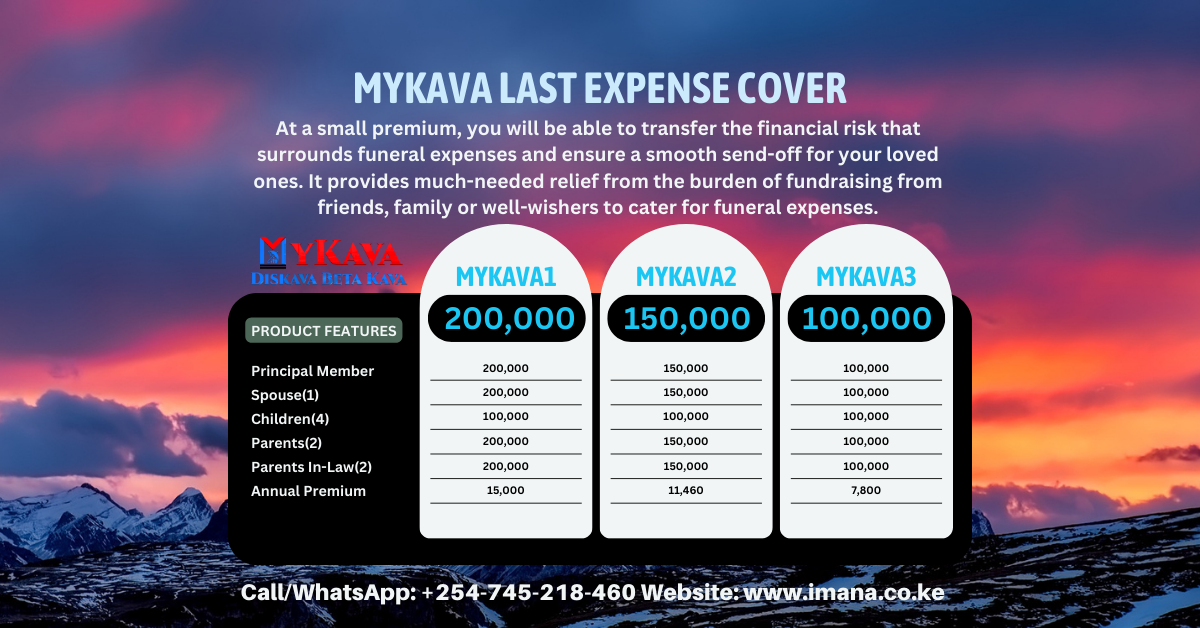
For example, if the selected funeral benefit is KSh 200,000, the maximum payment for an approved claim will generally be KSh 200,000, subject to the policy’s conditions.
Who Can Buy Last-Expense Cover in Kenya?
Last-expense insurance can be arranged by:
- Individuals
- Couples
- Families
- Employers
- SMEs
- Chamas
- Saccos
- Welfare associations
- Churches
- NGOs
- Professional associations
- Community groups
Each insurer applies its own minimum entry ages, maximum ages, benefit options and underwriting rules.
Who Can Be Included in a Family Funeral Plan?
A family last-expense plan may cover several relatives under one policy.
Principal member
The principal member is the main policyholder. This person normally completes the application, pays the premium and selects the people to be insured.
Spouse
A spouse may be included subject to the policy’s definition and eligibility requirements. Every spouse must be properly declared and accepted by the insurer.
Children
Eligible biological, legally adopted or recognised dependent children may be covered. Age limits usually apply.
Some insurers may extend cover for a child who is:
- In full-time education
- Financially dependent on the principal member
- Living with a qualifying permanent disability
The exact rules must be confirmed from the policy wording.
Parents and parents-in-law
Many funeral plans allow the principal member to add parents and parents-in-law. Because premiums are strongly influenced by age, older relatives may attract higher rates or lower benefit limits.
Extended-family members
Selected policies may allow other relatives, such as grandparents or siblings, to be added. The relationship, dependency and age requirements differ between insurers.
Never assume that someone is covered simply because their premium was discussed. Their name and details should appear on the accepted policy schedule or membership register.
Nuclear-Family Versus Extended-Family Cover
A nuclear-family funeral plan usually covers:
- Principal member
- Spouse
- Eligible children
An extended-family plan may add:
- Parents
- Parents-in-law
- Grandparents
- Siblings
- Other qualifying dependants
Extended-family cover can be useful in Kenya, where one person may carry financial responsibility for several households. However, adding more people increases the total premium.
Benefit limits and waiting periods may also differ between the principal member and extended-family members.
How Much Last-Expense Cover Do You Need?
The right benefit depends on the funeral expenses your family is likely to face.
Consider:
- Where the burial is likely to take place
- Distance from the mortuary to the burial location
- Body-transportation costs
- Number of family members likely to travel
- Mortuary charges
- Coffin and hearse expenses
- Cultural or religious arrangements
- Catering and accommodation
- Existing Sacco, employer or welfare benefits
- Available emergency savings
Commonly available benefit levels may start from modest amounts and extend to several hundred thousand shillings. Higher limits may be available for qualifying individuals or groups.
Do not choose a benefit solely because its premium is cheap. A very small benefit may provide limited help when the family actually needs it.
How Much Does Last-Expense Insurance Cost in Kenya?
There is no universal premium. The price depends on the insurer, benefit limit and people being covered.
Important pricing factors include:
- Age of the principal member
- Ages of dependants
- Number of insured family members
- Selected benefit limit
- Individual or group arrangement
- Nuclear or extended-family cover
- Maximum cover age
- Waiting period
- Premium-payment frequency
- Optional benefits
- Group size and claims experience
Some qualifying group last-expense plans may start from approximately KSh 1,200 per member per year. Individual and family premiums can be higher or lower depending on age, benefit and policy structure.
All prices should be treated as indicative until an insurer issues an official quotation.
Request current options through the Imana Insurance quotation comparison platform or the dedicated last-expense quotation page.
What Is a Waiting Period?
A waiting period is the time that must pass before the policy covers certain causes of death.
Natural death commonly attracts a waiting period. Accidental death may become eligible earlier, but this depends on the specific insurer and policy.
A separate exclusion period may also apply to suicide.
Before paying for a policy, confirm:
- The official commencement date
- Waiting period for natural death
- Treatment of accidental death
- Suicide exclusion period
- Waiting periods for dependants
- Rules for relatives added later
- Conditions for transferring existing cover
- Consequences of missing a premium
“Immediate cover” should never be accepted as a complete answer. Ask exactly which causes of death are covered immediately.
What Is Usually Not Covered?
A last-expense claim may not be payable where:
- Death occurs during an applicable waiting period
- The insured person was not declared or accepted
- The policy had lapsed
- Premiums were unpaid
- Incorrect information was supplied during application
- The insured person exceeded the permitted entry age
- The claimed relationship cannot be established
- Fraudulent documents are submitted
- The cause of death falls under an exclusion
- The claim is submitted outside the required notification period
- Suicide occurs during an applicable exclusion period
The list of exclusions differs between insurers. The official policy wording—not an advert, WhatsApp message or verbal promise—determines the cover.
Individual and Group Last-Expense Insurance
Individual cover
Individual last-expense insurance protects one person and provides a benefit to the nominated beneficiary or eligible claimant.
It may be suitable for:
- Self-employed individuals
- Young professionals
- People without employer benefits
- Parents who want a personal policy
- Individuals seeking additional protection
Family cover
Family cover brings several eligible relatives under one policy. It may simplify premium payments and policy administration.
Group cover
Group last-expense insurance protects members of an organisation under a master policy.
It may work well for:
- Employers
- Saccos
- Chamas
- Welfare associations
- Churches
- Professional organisations
- NGOs and community groups
Group schemes may provide favourable pricing through risk pooling, but minimum membership requirements can apply.
The organisation should maintain an accurate member register and promptly report additions, removals and changes.
Last-Expense Insurance Versus Life Insurance
Last-expense insurance is designed primarily for immediate funeral and burial costs.
Life insurance is broader. It may provide a larger benefit intended to:
- Replace lost household income
- Support dependants
- Pay school fees
- Clear a mortgage
- Settle debts
- Protect long-term family goals
A funeral benefit may carry a family through the first few days or weeks after a death. It may not replace the income the deceased would have earned over many years.
For many households, last-expense and life insurance should complement each other.
Last-Expense Cover Within Medical Insurance
Some medical insurance plans include a funeral or last-expense benefit. However, the benefit may be smaller than the amount available through a dedicated funeral policy.
Before relying on a medical-plan benefit, confirm:
- The benefit amount
- Covered family members
- Age limits
- Qualifying causes of death
- Whether parents are included
- Whether the benefit ends when medical cover ends
- Applicable waiting periods
A medical last-expense benefit may be useful, but it should not automatically be treated as complete funeral protection for an extended family.
Funeral Cover Through an Employer or Sacco
Some employers, Saccos and welfare groups provide funeral benefits to members. These arrangements can offer valuable protection, but they may depend on continued membership or employment.
Ask:
- Does the cover end when employment ends?
- Are dependants included?
- What benefit applies to each family member?
- Are parents covered?
- Who submits the claim?
- What happens after retirement or resignation?
- Can the member continue the policy privately?
Holding a personal last-expense policy can provide continuity when employer or group membership changes.
How to Choose the Right Last-Expense Policy
Identify everyone who needs cover
List the principal member, spouse, children, parents and other dependants before requesting quotations.
Choose a practical benefit
Estimate realistic funeral expenses. Avoid selecting a benefit that looks impressive but creates an unaffordable premium.
Compare policy terms
Look beyond the premium and compare:
- Benefit limits
- Entry and expiry ages
- Waiting periods
- Exclusions
- Family definitions
- Premium-payment terms
- Claims documentation
- Territorial limits
- Renewal conditions
Disclose information honestly
Provide accurate ages, identification details, relationships and health information where requested.
Non-disclosure can turn an affordable policy into a worthless piece of paper when a claim occurs.
Nominate an appropriate beneficiary
Where the policy permits beneficiary nomination, choose someone who can responsibly handle the benefit. Keep the nomination and contact details current.
Tell your family about the cover
A policy cannot help efficiently if nobody knows it exists. Share the insurer’s name, policy number, intermediary contact and storage location of the documents with a trusted family member.
Documents Required for a Last-Expense Claim
The claimant should notify the insurer or intermediary as soon as reasonably possible.
Documents commonly requested include:
- Completed claim form
- Death certificate or acceptable notification of death
- Burial permit
- Deceased person’s ID
- Claimant’s ID
- Proof of relationship
- Policy schedule or membership certificate
- Claimant’s bank or approved payment details
- Police abstract for accidental or reportable death
- Medical or post-mortem report where required
- Employer or group confirmation for group cover
The insurer may request additional documents depending on the circumstances of death.
Complete, accurate and legible documentation helps prevent unnecessary delays.
How Long Does a Last-Expense Claim Take?
There is no single payout period that applies to every claim.
Processing time depends on:
- Policy status
- Completion of the waiting period
- Cause of death
- Completeness of documents
- Confirmation of identity and relationship
- Need for further investigation
- The insurer’s claims procedures
Some insurers promote fast last-expense settlements, but payment is normally subject to receiving and validating all required documents.
Avoid treating “payment within 48 hours” as unconditional. Ask when that period begins and what documentation must first be completed.
Common Mistakes to Avoid
Families can reduce future claim problems by avoiding these mistakes:
- Insuring a relative without confirming eligibility
- Giving an incorrect date of birth
- Assuming every dependant receives the same benefit
- Ignoring the waiting period
- Missing premium payments
- Failing to update the beneficiary
- Not adding a newborn or new spouse
- Depending solely on verbal explanations
- Buying based only on price
- Keeping the policy secret from the family
- Submitting incomplete claim documents
Insurance works best when the paperwork is correct before the difficult day arrives.
Frequently Asked Questions
Is last-expense insurance mandatory in Kenya?
No. It is a voluntary form of financial protection.
Can I cover my parents?
Many policies permit parents and parents-in-law, subject to entry ages, benefit limits and premiums.
Can one policy cover my entire extended family?
Some policies allow several relatives, but eligibility and maximum member numbers vary.
Does last-expense insurance cover natural death?
It may cover natural death after the applicable waiting period, subject to policy terms and exclusions.
Is accidental death covered immediately?
Some policies treat accidental death differently, but immediate protection should not be assumed. Confirm the commencement terms in writing.
Can I take more than one funeral policy?
It may be possible, but all information must be accurately disclosed. Each claim is independently assessed under its policy.
What happens if I stop paying?
The policy may lapse after any applicable grace period. A claim arising while cover is inactive may be declined.
Can the benefit be used for expenses other than the funeral?
A lump-sum benefit is generally flexible, but the claimant should confirm any restrictions in the policy.
Compare Last-Expense Insurance Quotes in Kenya
The best last-expense cover is not automatically the cheapest. It is the policy that covers the right people, provides a meaningful benefit and has terms the family understands.
Imana Insurance Agency Kenya Ltd helps individuals, families, employers, Saccos, chamas and welfare groups compare options from participating insurance companies.
Start here:
- Compare insurance quotations
- Request a last-expense quotation
- Visit the Imana Insurance authority website
- Explore travel and insurance through MyKava
- Contact Imana Insurance Agency
Contact Imana Insurance Agency Kenya Ltd
Imana Insurance Agency Kenya Ltd
4th Floor, Krishna Centre
Woodvale Grove, Westlands, Nairobi, Kenya
Call/WhatsApp: +254 796 209 402
Email: insurance@imana.co.ke
Quotation comparison: https://imanainsurance.com
Authority website: https://imana.co.ke
Travel and insurance: https://mykava.co.ke
Author: Raymond Momanyi
Founder & CEO, Imana Insurance Agency Kenya Ltd
Disclaimer: This article provides general information and does not constitute an insurance quotation or guarantee of cover or claim payment. Premiums, benefits, waiting periods, age limits, exclusions and claims requirements vary by insurer. Review the official quotation, policy schedule and complete policy wording before purchasing cover.