- Author: Raymond
- Category: Travel Insurance in Kenya
Kenya eTA vs eCitizen Insurance Portal: Which One to Use?
Confused by Kenya's eTA and eCitizen insurance portals? Learn what each platform does, who should use it and how travel insurance links to an eTA.
etakenya.go.ke; insurance.ecitizen.go.ke; Kenya mandatory travel insurance portal; Kenya eTA application; inbound travel health insurance Kenya; Kenya entry requirements 2026
Kenya's eTA and eCitizen Insurance portals serve different purposes. One handles travel authorisation; the other issues inbound travel health insurance. This guide explains when to use each platform, how they connect and how to avoid paying twice.
Author: Raymond Momanyi, Founder & CEO, Imana Insurance Agency Kenya Ltd
Last reviewed: 17 October 2026
Kenya eTA vs eCitizen Insurance Portal: What Is the Difference and Which One Should You Use?
If you are planning to visit Kenya, you may encounter two official websites:
Both portals form part of Kenya's digital travel-compliance process, and both may ask for similar details such as your nationality, passport information and travel dates. That similarity is causing confusion among applicants.
Some travellers think they must choose one website and ignore the other. Others assume that buying insurance automatically creates an Electronic Travel Authorisation. A few begin applications on both portals and worry that they may be paying twice.
Here is the simplest explanation:
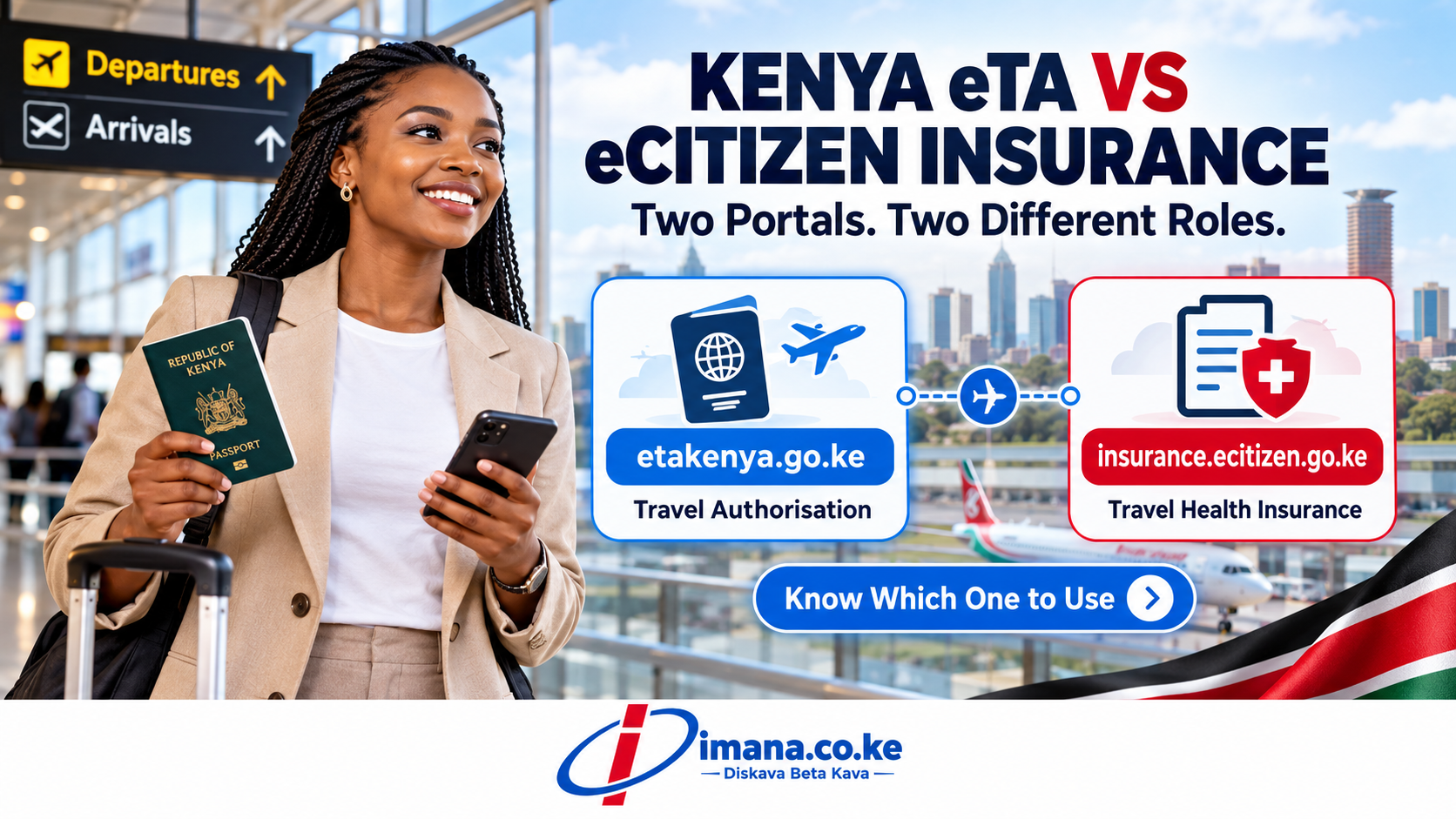
The Kenya eTA portal deals with permission to travel. The eCitizen Insurance portal deals with the required insurance policy.
The systems can communicate with each other, but they perform different legal and administrative roles.
This guide explains the distinction, how the two portals connect and which route to follow depending on your situation.
Quick answer
Use etakenya.go.ke when you need to apply for, pay for, track or validate a Kenya Electronic Travel Authorisation.
Use insurance.ecitizen.go.ke when you need to buy, retrieve or manage Kenya's inbound travel health insurance separately.
If you require an eTA, you may be prompted to satisfy the insurance requirement during the eTA application. If you buy the insurance first through eCitizen, the eTA system may recognise it using your passport details.
What is etakenya.go.ke?
etakenya.go.ke is the official Electronic Travel Authorisation portal operated under Kenya's Directorate of Immigration Services.
Its primary role is to assess whether an applicant is eligible to travel to Kenya. The eTA replaced the traditional visa requirement for many foreign visitors, although exemptions apply to several nationalities and traveller categories.
An approved eTA gives a traveller permission to begin the journey to Kenya. It does not guarantee entry. The final decision on admissibility is made by immigration officers at the point of entry.
What can you do on the Kenya eTA portal?
The portal allows an eligible traveller or authorised representative to:
- Start an individual or group eTA application
- Submit passport and biographical information
- Provide a photograph or selfie
- Submit travel dates and itinerary details
- Provide accommodation information
- Upload documents connected to the purpose of travel
- Pay the applicable eTA fee
- Track the status of an application
- Download an approved eTA
- Validate an eTA
- Review eTA eligibility, exemptions and frequently asked questions
The official guidance says eTA applications are generally processed within three working days, although they can take longer. Travellers are encouraged to apply at least two weeks before travel.
What documents may the eTA application require?
The published requirements include:
- A passport valid for at least six months with a blank page
- A selfie or passport-style photograph
- Email address and telephone number
- Arrival and departure itinerary
- Accommodation confirmation
- A payment method
Additional documents may be required for business travel, conferences, medical visits, employment, family visits or diplomatic travel.
What does the eTA portal not do?
The eTA portal is not an insurance marketplace by itself. Its principal decision is whether to approve or refuse travel authorisation.
Although an insurance-verification or purchase step may appear inside the eTA journey, the insurance transaction belongs to the separate inbound travel health insurance system. An eTA approval should therefore not be mistaken for an insurance certificate.
What is insurance.ecitizen.go.ke?
insurance.ecitizen.go.ke is an official eCitizen insurance platform. It provides access to insurance services offered through approved and licensed insurers.
The homepage currently lists services including Marine Cargo Insurance and Inbound Travel Health Insurance. For foreign visitors, the relevant service is Inbound Travel Health Insurance.
Its role is to issue or facilitate the insurance policy—not to determine whether the traveller is authorised to enter Kenya.
What can you do on the eCitizen Insurance portal?
The insurance journey currently presents a process that allows an applicant to:
- Select an insurance service
- Choose from available insurers where applicable
- Review an insurer's offering
- Enter the traveller's details
- Provide nationality and applicant type
- Submit passport information
- Upload or capture a selfie or photograph
- Provide contact and travel information
- Review a quotation
- Pay for the selected policy
- Receive or download the digital policy
- Retrieve or check the insurance status
The portal's published flow is: Select Service → Select Insurer → Review Offering → Your Quote → Checkout.
What does the eCitizen Insurance portal not do?
Buying inbound travel health insurance on this portal does not create an eTA application.
If your nationality or traveller category requires an eTA, you must still apply separately through etakenya.go.ke. The insurance portal may inform you that an eTA is required, but it does not replace the immigration assessment.
Why do the two portals appear connected?
They are designed to exchange insurance-status information using the traveller's identifying details, particularly the passport record.
For a traveller who requires an eTA, the process may work in either of two ways:
Route 1: Start with the eTA portal
- Visit etakenya.go.ke.
- Complete the eTA application details.
- When the insurance-verification step appears, check whether valid insurance is already linked.
- If none is found, follow the official prompt to obtain the mandatory cover.
- Return to or continue with the eTA process.
- Pay and submit the eTA application.
- Track the application until a decision is issued.
This is usually the clearest route for a traveller who knows they require an eTA and has not bought the inbound policy.
Route 2: Buy the insurance first
- Visit insurance.ecitizen.go.ke.
- Select Inbound Travel Health Insurance.
- Enter the traveller's nationality, passport, contact and travel information.
- Review the insurance offering and quotation.
- Pay and retain the policy document and insurance reference.
- Visit etakenya.go.ke if an eTA is required.
- Enter exactly the same passport and personal details.
- Allow the eTA system to search for and confirm the insurance record.
- Complete and submit the eTA application.
This route may be useful for a traveller who wants to obtain insurance before beginning an eTA application, or for an affected traveller who is exempt from obtaining an eTA but still needs the insurance.
Which portal should you use first?
The best starting point depends on your status.
If your nationality requires an eTA
Start at etakenya.go.ke. The portal guides you through the travel-authorisation process and may direct you to the insurance step before submission.
You may also purchase the insurance first through eCitizen, but you must still return to the eTA portal to apply for travel authorisation.
If you are exempt from an eTA but still require inbound insurance
Use insurance.ecitizen.go.ke to obtain the policy separately.
This category is particularly important because eTA exemption and insurance exemption are not necessarily the same thing. A traveller should not assume that being allowed to travel without an eTA automatically removes every insurance requirement.
If you are exempt from both requirements
You should not submit or pay for applications that do not apply to you. Verify your exemption using the current official guidance and retain supporting documents in case an airline or border officer asks for proof.
If you already have an approved eTA but no insurance
Do not start and pay for a second eTA merely to reach the insurance screen. Check the current instructions and, where required, obtain the policy separately through insurance.ecitizen.go.ke.
Keep the insurance policy or reference available when travelling.
If you already bought the insurance separately
Do not immediately buy another policy when the eTA portal initially says that no insurance has been found.
First:
- Confirm that the passport number was entered correctly on both applications
- Confirm that the name and date of birth match the passport
- Use the available insurance-status or search function
- Check the insurance reference and policy status
- Allow for possible processing or system-sync delays
- Contact the official support channel if the record remains unavailable
Only make another payment after confirming that the existing transaction failed or cannot be recognised.
The biggest mistake: confusing an eTA with insurance
The eTA and the insurance policy answer two different questions.
The eTA asks:
Has Kenya authorised this traveller to begin the journey and present themselves for entry?
The insurance policy asks:
Does this traveller have the required health-insurance protection for the visit?
You may need both answers to be “yes.” One document cannot automatically substitute for the other.
Why do both portals ask for passport and travel information?
The information serves different purposes.
The eTA portal uses it for identity, eligibility, immigration and travel-authorisation checks.
The insurance portal uses it to identify the insured traveller, determine the applicable cover, issue the policy and connect that policy to the traveller's passport record.
Matching information also allows the two systems to communicate. This is why applicants must avoid nicknames, shortened names, transposed passport digits or different travel dates unless the itinerary has genuinely changed.
Does buying insurance guarantee eTA approval?
No.
Insurance compliance is only one part of the process. Immigration authorities may still assess the traveller's passport, purpose of visit, itinerary, accommodation, supporting documents and other eligibility information.
Paying for insurance should never be presented as a promise that an eTA will be approved or that admission at the Kenyan border is guaranteed.
Does an approved eTA prove that the traveller is insured?
Not always. Travellers should retain their insurance policy or reference separately, even if the eTA application displays a valid insurance status.
Keep both documents available digitally and, where possible, in printed form:
- The approved eTA PDF, where required
- The inbound travel health insurance policy or confirmation
- Payment receipts
- The passport used in both applications
- Emergency-assistance and claims contacts
Can someone apply on behalf of a traveller?
The eTA portal permits another person to apply on behalf of a traveller, provided the traveller's information is entered correctly and the representative indicates that they are applying for someone else.
The insurance portal also accommodates individual applications and the addition of family members. The person completing either process must use the actual traveller's passport and personal details—not the payer's details in place of the traveller's identity.
Each traveller must be correctly reflected in the resulting authorisation or policy.
What if the two systems do not match the insurance record?
Before paying again, check the following:
- Passport number: Ensure there is no missing letter, extra space or confusion between characters such as zero and the letter O.
- Name order: Use names exactly as printed in the machine-readable passport section.
- Date of birth: Confirm the day, month and year.
- Nationality: Select the passport-issuing country used for the trip.
- Policy status: Confirm that payment succeeded and the policy is active or valid.
- Reference number: Retrieve the insurance reference from the confirmation email or portal.
- Email folders: Check spam or junk folders for receipts and policy documents.
- Processing time: Allow reasonable time for the records to synchronise.
If the problem persists, use the support contact shown on the relevant official portal. Contact eTA support for an eTA application issue and the insurance portal or issuing insurer for a policy or payment issue.
How to know which support team to contact
Contact the Kenya eTA support team when the problem concerns:
- eTA eligibility or exemptions
- An eTA application reference
- Application status
- Delayed eTA processing
- An approval or refusal decision
- Downloading or validating the eTA
- Incorrect information in an eTA application
The official eTA website currently publishes assistance channels on its homepage and help pages.
Contact the eCitizen Insurance portal or issuing insurer when the problem concerns:
- Selecting the inbound insurance service
- The insurance quotation
- Policy payment
- Failure to receive the insurance document
- Retrieving an insurance reference
- Insurance status
- Policy benefits, exclusions or claims
- A mismatch between the policy and passport details
This separation can save hours of being redirected between teams.
Common questions travellers are asking
Are etakenya.go.ke and insurance.ecitizen.go.ke both official websites?
Yes. The eTA site is operated under Kenya's Directorate of Immigration Services, while the eCitizen insurance site provides government-linked access to authorised insurance services.
Always type or verify the addresses carefully. Fraudulent websites can imitate government pages.
Must I create applications on both websites?
Not necessarily. If you require an eTA and begin at the eTA portal, the linked journey may allow you to satisfy the insurance step without independently starting from the insurance homepage.
If you buy insurance separately, you will still need an eTA application if your traveller category requires one.
Will buying insurance on eCitizen automatically submit my eTA?
No. It may create a policy record that the eTA system can detect, but it does not submit an immigration application.
Will starting an eTA automatically buy the insurance?
No. You must review and authorise any insurance transaction presented during the process. Check the quoted amount and confirmation before proceeding.
Can I pay once for a whole family?
The portals may permit a group or family journey, but each traveller must be individually identified and appropriately covered. Review the passenger list before payment and confirm that every person appears in the issued documents.
What if I am from an eTA-exempt African country?
First verify your eTA exemption on the official eTA website. Then separately check whether you are exempt from the inbound insurance requirement. Do not treat the first exemption as automatic proof of the second.
Is the insurance fee part of the eTA fee?
No. They are charges for different products and processes. The eTA fee relates to travel-authorisation processing. The insurance premium pays for the insurance policy. Additional platform or payment charges may also appear.
Can Imana issue the eTA?
No. The eTA is issued by the Government of Kenya through the official eTA system. Imana Insurance Agency Kenya Ltd does not make immigration decisions and cannot guarantee approval.
Can Imana help with insurance?
Imana is a Kenya-based insurance intermediary. It can explain insurance concepts and help travellers compare additional travel-insurance options from licensed Kenyan insurers. The mandatory inbound policy itself should be obtained through the officially designated process where required.
A simple pre-travel checklist
Before boarding a flight to Kenya:
- Confirm whether your nationality and travel status require an eTA
- Confirm separately whether inbound travel health insurance applies
- Use only etakenya.go.ke and insurance.ecitizen.go.ke
- Enter passport information consistently on both systems
- Avoid paying twice before investigating an unrecognised policy
- Download the approved eTA where required
- Download the insurance policy or confirmation
- Keep payment receipts and reference numbers
- Carry offline and printed copies
- Recheck official rules shortly before departure
Beyond entry compliance: consider broader travel protection
The mandatory inbound health policy is intended to meet Kenya's prescribed entry-related health-insurance requirements. It should not automatically be treated as comprehensive protection for every travel risk.
Depending on the policy wording, broader travel insurance may provide benefits for trip cancellation, travel interruption, baggage loss, delays, personal accident, personal liability or higher medical limits.
For insurance quotation comparison, visit imanainsurance.com, the conversion and quotation platform for Imana Insurance Agency Kenya Ltd. You can also review travel insurance in Kenya or visit the Imana insurance authority website.
For travel planning, accommodation, tours and related support, visit MyKava Travel and Tours Agency. Insurance services remain handled separately through Imana Insurance Agency Kenya Ltd.
Final word
The two portals are not rivals and they are not duplicates.
etakenya.go.ke answers the immigration question: Are you authorised to travel to Kenya?
insurance.ecitizen.go.ke answers the insurance question: Do you have the required inbound travel health policy?
Where both requirements apply, complete both carefully, use identical passport details and retain both documents. Two portals, two different roles, one smoother journey when the sequence is understood.
About the author
Raymond Momanyi is the Founder & CEO of Imana Insurance Agency Kenya Ltd, a Westlands-based insurance intermediary helping individuals, families and businesses compare quotations from licensed Kenyan insurers across Travel, Medical, Motor, WIBA, PSV, Motorcycle, Cyber, SME/Corporate and other insurance classes.
Contact Imana
Call/WhatsApp: +254 796 209 402
Office: 4th Floor, Krishna Centre, Woodvale Grove, Westlands, Nairobi, Kenya
Websites: imanainsurance.com | imana.co.ke | mykava.co.ke
Disclaimer: This article provides general information based on the official portals as reviewed on 17 October 2026. Entry requirements, exemptions, portal processes, insurance terms, charges and system behaviour may change. An eTA does not guarantee admission, and insurance cover remains subject to the issuing insurer's terms, conditions, exclusions, limits and claims procedures. Confirm current requirements directly through the official government portals before travelling.