- Author: Raymond
- Category: Insurance Claims
How to File a Motor Insurance Claims in Kenya
Learn how to file a motor insurance claim in Kenya after an accident, theft, fire or third-party loss. Understand the documents, assessment, repairs, excesses and claim process.
What Should You Do After a Motor Accident?
A road accident can be confusing and stressful. Drivers may disagree about who caused it, vehicles may block traffic and bystanders may begin offering conflicting advice.
Your first priority should be safety—not deciding liability or negotiating payment at the scene.
After confirming that everyone is safe, you should preserve evidence, report the incident where required and notify your insurance company or intermediary as soon as reasonably possible.
The Insurance Regulatory Authority’s standard Private Motor Insurance Policy requires policyholders to report any accident, injury, loss or damage involving the insured vehicle as soon as reasonably possible. (Insurance Regulatory Authority)
A good motor claim begins at the accident scene. The photographs, reports and decisions made during the first few hours can affect the entire claim process.
What Is a Motor Insurance Claim?
A motor insurance claim is a formal request asking an insurance company to provide compensation or another policy benefit following an insured event.
A motor claim may arise from:
- Accidental vehicle damage
- Theft of the vehicle
- Theft of insured vehicle parts
- Fire damage
- Malicious damage
- Third-party bodily injury
- Third-party death
- Damage to another person’s property
- Windscreen damage
- Towing or recovery costs
- Other insured risks
The insurer must confirm:
- The policy was active
- The insured vehicle was correctly described
- The driver was authorised and properly licensed
- The vehicle was being used for the declared purpose
- The event falls within the policy
- The policyholder followed the claims conditions
- The amount claimed is reasonable
- No exclusion applies
Submitting a claim does not automatically guarantee payment.
Which Motor Insurance Covers Can Produce a Claim?
Comprehensive Motor Insurance
Comprehensive Insurance may cover:
- Damage to your own vehicle
- Theft
- Fire
- Third-party liabilities
- Other insured risks
The cover remains subject to excesses, limits and exclusions.
Third Party, Fire and Theft
This may cover:
- Third-party liabilities
- Fire damage to the insured vehicle
- Theft of the insured vehicle
It does not ordinarily cover accidental collision damage to your own vehicle.
Third-Party Only Insurance
Third-Party Only Insurance primarily protects against specified liabilities involving other people.
It generally does not pay to repair your own vehicle after an accident.
Kenya’s Insurance (Motor Vehicle Third Party Risks) Act requires vehicles used on public roads to have insurance against specified third-party risks. (Kenya Law)
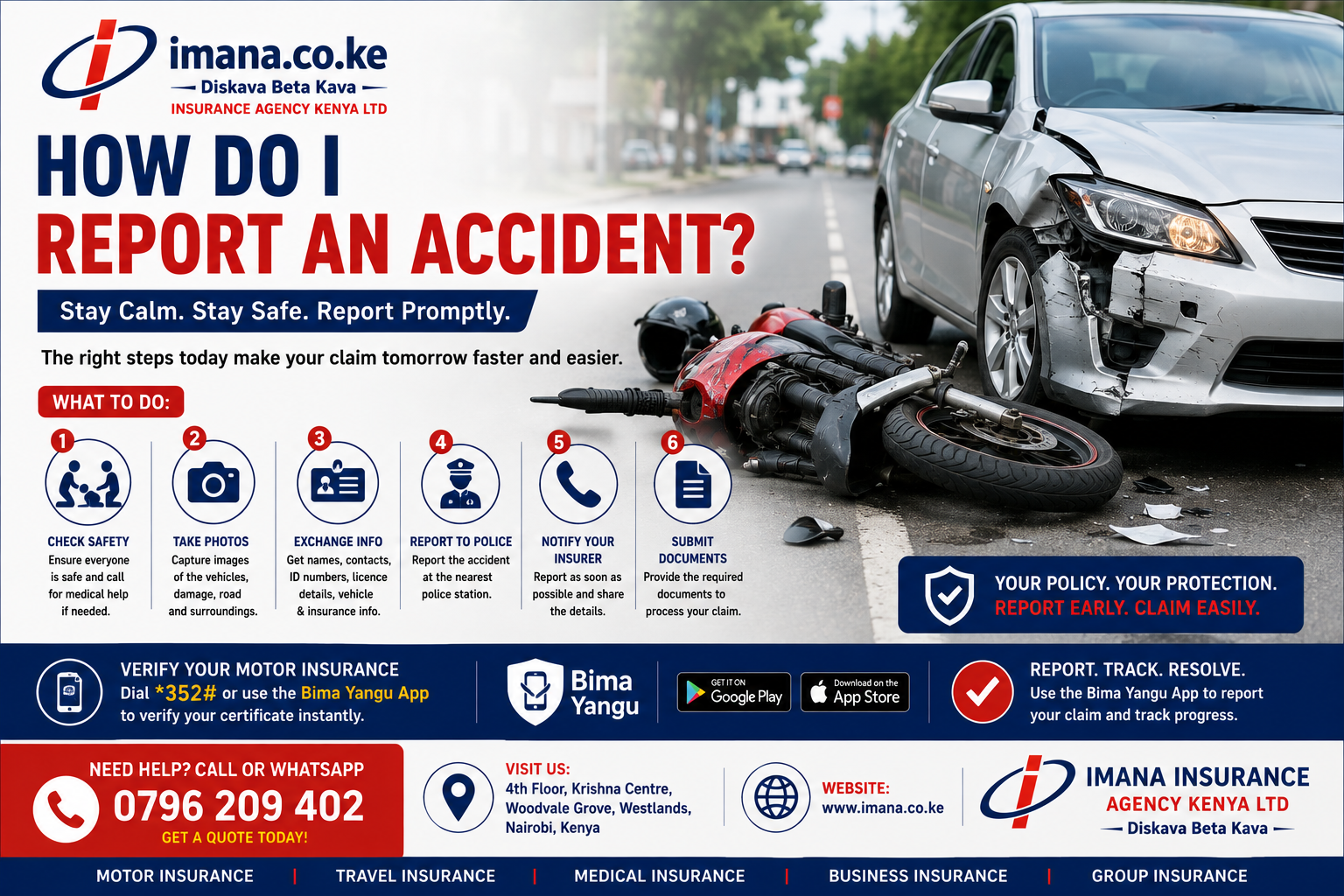
Step-by-Step: How to File a Motor Insurance Claim in Kenya
Step 1: Stop Safely
After an accident:
- Stop the vehicle.
- Switch on hazard lights.
- Move to a safe position where possible.
- Avoid standing in moving traffic.
- Warn other motorists where necessary.
Do not drive away from an accident scene without taking the steps required by law and the circumstances.
Where moving the vehicle is necessary for safety or traffic flow, first take clear photographs showing its original position where reasonably possible.
Step 2: Check Whether Anyone Is Injured
Confirm the condition of:
- Drivers
- Passengers
- Pedestrians
- Motorcyclists
- Other road users
Call emergency medical services where necessary.
Do not move a seriously injured person unless they face an immediate danger such as fire or moving traffic and it is necessary to protect them.
Step 3: Call the Police Where Required
Police reporting is particularly important where the accident involves:
- Bodily injury
- Death
- Serious vehicle damage
- Disagreement over how the accident occurred
- A hit-and-run driver
- Theft
- Malicious damage
- Public property
- An uninsured or unidentified vehicle
The police may record the incident and later issue a police abstract or other relevant documentation.
A police abstract records the reported accident. It does not automatically prove which driver was legally responsible.
Step 4: Take Photographs and Videos
Capture the accident scene before vehicles are moved where it is safe to do so.
Take photographs showing:
- All vehicles involved
- Registration numbers
- Vehicle positions
- Damage to each vehicle
- Road markings
- Traffic signs
- Traffic lights
- Debris
- Skid marks
- Weather and road conditions
- Nearby buildings or landmarks
- Third-party property damage
Take both wide-angle and close-up images.
The Association of Kenya Insurers’ Bima Yangu platform allows motorists to capture and upload photographs and videos, geolocate an accident scene and send claim information to the insurer. (akinsure.com)
Step 5: Exchange Information
Collect the other driver’s:
- Full name
- Telephone number
- National ID or passport details
- Driving-licence details
- Vehicle registration number
- Insurance company
- Policy or certificate number
- Employer or vehicle-owner information where applicable
Also record:
- Passenger details
- Witness names
- Witness telephone numbers
- Police officer’s details
- Police station and occurrence-book reference where available
Do not rely only on a photograph of the other vehicle.
Step 6: Do Not Admit Liability
Avoid statements such as:
- “It was completely my fault.”
- “My insurer will pay everything.”
- “I will repair your car.”
- “Let us settle this privately.”
You can cooperate, exchange information and assist injured people without accepting legal liability.
The insurer must investigate the facts before determining how the policy responds.
Step 7: Do Not Negotiate Cash at the Scene
Some drivers immediately demand cash for:
- Repairs
- Towing
- Medical treatment
- Missed work
- Damaged property
Paying money or signing an agreement without insurer approval can complicate the claim.
Where an urgent medical expense must be addressed, keep all receipts and notify the insurer immediately.
Step 8: Notify Imana or the Underwriting Insurer
Report the incident as soon as possible.
Provide:
- Policyholder’s name
- Vehicle registration
- Policy number
- Date and time
- Location
- Basic description
- Other vehicles involved
- Whether anyone was injured
- Police-reporting details
- Current location of the vehicle
Prompt notification allows the insurer to:
- Register the claim
- Issue a claim reference
- Advise on documents
- Arrange towing
- Appoint an assessor
- Approve a garage
- Investigate the accident
- Contact third parties
The standard private motor policy published by IRA requires prompt reporting of accidents, injuries, losses and damage. (Insurance Regulatory Authority)
Step 9: Complete the Motor Claim Form
The insurer will normally provide a motor claim form.
Complete it accurately and consistently.
Information may include:
- Insured’s details
- Vehicle details
- Driver’s details
- Date and time of accident
- Location
- Purpose of the journey
- Speed and direction
- Weather conditions
- Description of damage
- Other vehicles
- Injuries
- Witnesses
- Police station
- Previous accidents
- Sketch of the accident
Do not exaggerate, guess or change the account to influence the claim.
Where you do not know an answer, state that clearly rather than providing false information.
Step 10: Submit the Required Documents
Documents commonly requested for an own-damage motor claim include:
- Completed claim form
- Police abstract
- Copy of driving licence
- Copy of national ID or passport
- Copy of KRA PIN
- Copy of logbook
- Insurance certificate
- Policy schedule
- Photographs
- Repair estimate
- Vehicle valuation report
- Inspection report
- Towing receipt
- Statements or witness details
Additional documents may be required depending on the accident.
The Bima Yangu App supports uploading documents such as a driving licence and police abstract when reporting a motor claim. (akinsure.com)
Step 11: Allow the Vehicle to Be Assessed
The insurer may appoint a motor assessor to inspect the vehicle.
The assessor may examine:
- Accident damage
- Pre-existing damage
- Repair method
- Required spare parts
- Labour charges
- Vehicle value
- Whether repairs are economical
- Whether the damage matches the reported accident
- Salvage value
Do not begin major repairs before the insurer or assessor has inspected and authorised the work.
Emergency action may be taken to prevent additional damage, but it should be documented.
Step 12: Use an Approved Garage
Depending on the insurer and policy, the vehicle may be sent to:
- An insurer-appointed garage
- A dealership
- A garage proposed by the policyholder
- A specialised repairer
Approval is important because the insurer may need to agree on:
- Repair cost
- Parts
- Labour
- Repair time
- Quality standards
- Warranty
- Payment arrangement
Choosing a garage without approval can result in disagreement over costs.
Step 13: Approve the Repair Scope
Once the insurer receives the assessor’s report, it may:
- Approve repairs
- Request another quotation
- Approve specific parts
- Negotiate labour charges
- Require additional inspection
- Declare the vehicle a total loss
- Request further investigation
Ask for clarity about:
- Approved repair amount
- Applicable excess
- Betterment contribution
- Excluded damage
- Expected repair period
- Parts availability
- Courtesy-car benefit where applicable
Step 14: Pay the Applicable Excess
An excess is the portion of an approved claim that the policyholder contributes.
Possible motor excesses include:
- Standard own-damage excess
- Theft excess
- Young-driver excess
- Inexperienced-driver excess
- Flood excess
- Windscreen excess
- Political-violence excess
An Excess Protector extension may reimburse or remove certain own-damage excesses, subject to its conditions.
It may not remove every additional excess.
Step 15: Inspect the Vehicle After Repairs
Before accepting the repaired vehicle:
- Examine the repaired sections.
- Test lights and safety systems.
- Check panel alignment.
- Confirm paint matching.
- Review warning lights.
- Take a test drive where permitted.
- Report defects immediately.
Sign the discharge or satisfaction document only after confirming the agreed repair work has been completed.
How to Report a Claim Through Bima Yangu
The Association of Kenya Insurers’ Bima Yangu App enables consumers to:
- Verify motor-insurance status
- Report an accident
- Report stolen vehicle parts
- Report a stolen vehicle
- Geolocate the accident scene
- Upload photographs and videos
- Upload claim documents
- Track the reported claim
- Locate emergency, ambulance or towing support
Consumers without smartphones can access some insurance services through the *352# USSD channel. (akinsure.com)
You should still notify your insurer or intermediary directly, especially after a serious accident.
How to File a Vehicle-Theft Claim
If your vehicle is stolen:
Report to the police immediately
Provide:
- Registration number
- Make and model
- Colour
- Chassis number
- Engine number
- Tracking information
- Last known location
- Time discovered missing
- Person last in possession
Notify the insurer
Do not wait to see whether the vehicle will be recovered.
Notify the tracking company
Ask for:
- Tracking activation
- Movement report
- Recovery support
- Written incident report
Preserve all keys
The insurer may request every original and duplicate key.
Submit theft documents
These may include:
- Claim form
- Police abstract
- Investigation report
- Logbook
- ID and KRA PIN
- Vehicle keys
- Purchase documents
- Finance documents
- Tracking report
- Statement explaining the theft
- Transfer or discharge documents
The insurer may wait for police investigations or the policy’s prescribed theft period before treating the vehicle as unrecovered.
How to File a Theft-of-Parts Claim
Where items such as mirrors, lights, tyres or other insured components are stolen:
- Do not disturb the scene unnecessarily.
- Take photographs.
- Report to the police.
- Notify the insurer.
- Complete the claim form.
- Obtain replacement quotations.
- Allow inspection before replacement.
The policy may apply:
- Theft excess
- Depreciation
- Betterment
- Accessory limits
- Security requirements
Personal belongings left inside a vehicle are not automatically covered by a motor policy.
How to File a Windscreen Claim
A windscreen claim may require:
- Claim form
- Photograph of the damaged windscreen
- Policy schedule
- Vehicle details
- Replacement quotation
- Police report where applicable
- Inspection or insurer approval
Check whether the policy has:
- A separate windscreen limit
- An excess
- An approved supplier
- A limit for tinting or sensors
- Conditions for recalibration of driver-assistance systems
A vehicle with cameras, rain sensors or advanced driver-assistance equipment may require specialised replacement and calibration.
How to File a Third-Party Motor Claim
A third-party claim is made against the insurance company covering the person alleged to have caused the accident.
Suppose another driver damages your vehicle and you wish to claim against that driver’s insurer.
You may need:
- Police abstract
- Demand letter
- Repair estimates
- Assessor’s report
- Photographs
- Logbook
- ID and KRA PIN
- Evidence of insurance
- Proof of ownership
- Witness statements
- Court judgment where liability is disputed
The third-party insurer will investigate:
- Whether its policy was active
- Whether its insured was involved
- Whether its insured was legally liable
- Whether the driver was authorised
- Extent of the damage
- Reasonableness of the amount claimed
A police abstract alone does not establish final legal liability.
Should you claim under your comprehensive policy instead?
Where you have Comprehensive Insurance, you may submit an own-damage claim to your insurer.
Your insurer may then seek recovery from the responsible driver or insurer through subrogation.
This may be faster than waiting for a disputed third-party claim, but excesses and policy terms will apply.
What Is Subrogation?
Subrogation allows an insurer that has paid an eligible claim to pursue recovery from the responsible third party.
After paying for your vehicle repairs, your insurer may seek reimbursement from:
- Another driver
- Another driver’s insurer
- A company
- A contractor
- Another legally responsible party
You should not sign an agreement releasing a responsible party without your insurer’s consent because doing so may interfere with recovery rights.
What Happens If Both Drivers Have Third-Party Insurance?
Each Third-Party Only policy protects against the insured driver’s specified liability to other people.
It does not ordinarily repair the policyholder’s own vehicle.
Where Driver A is responsible:
- Driver B may claim against Driver A or Driver A’s insurer.
- Driver A normally pays for their own vehicle repairs.
- Driver A’s policy may address eligible third-party liabilities.
Where liability is disputed, the parties may require investigation, negotiation or court determination.
What Happens When Liability Is Shared?
An accident may involve contributory negligence.
For example, one driver may be found 70% responsible and the other 30% responsible.
A third-party settlement may then reflect the determined proportions.
The insurer, lawyers or court may review:
- Police evidence
- Witness accounts
- Road position
- Traffic rules
- Vehicle damage
- Expert reports
- Dashcam or CCTV footage
Do not assume that one driver must always carry 100% of the responsibility.
What Is a Total-Loss Claim?
A vehicle may be declared a total loss when:
- It is destroyed beyond economical repair.
- Repair costs are too high relative to its value.
- Safe repair is impractical.
- It is stolen and not recovered.
The insurer may consider:
- Pre-accident market value
- Policy sum insured
- Valuation
- Vehicle condition
- Underinsurance
- Excess
- Salvage
- Outstanding premium
- Financier’s interest
The printed sum insured is not always the automatic settlement amount.
What Is Salvage?
Salvage is the damaged vehicle or remaining parts after a total-loss settlement.
Depending on the settlement:
- The insurer may retain the salvage.
- The insurer may sell it.
- The policyholder may retain it after an agreed deduction.
- A financier’s interest may be considered.
Do not remove or sell parts before the insurer has assessed the vehicle.
Can the Insurer Use Second-Hand or Alternative Parts?
The repair method depends on:
- Vehicle age
- Policy terms
- Availability
- Assessor’s recommendation
- Safety requirements
- Repair standards
- Insurer approval
Where a new component improves the vehicle beyond its pre-accident condition, the insurer may apply a betterment contribution.
Safety-critical repairs should meet appropriate standards.
What Is Betterment?
Betterment occurs when repairs or replacements leave the vehicle in a better condition than before the accident.
For example, replacing a heavily worn tyre with a new tyre may improve the vehicle beyond its pre-loss condition.
The policyholder may be asked to contribute towards that improvement.
Betterment should be distinguished from the policy excess.
Can You Receive Cash Instead of Repairs?
An insurer may sometimes offer a cash settlement instead of arranging repairs.
Before accepting, confirm:
- Settlement amount
- Excess deduction
- Betterment
- VAT treatment
- Whether the payment is final
- Whether hidden damage is included
- Whether the vehicle remains roadworthy
- Whether a financier must approve
A cash settlement may transfer responsibility for repairs to the policyholder.
Common Reasons Motor Claims Are Delayed
Motor claims may be delayed by:
- Incomplete documents
- Missing police abstract
- Late notification
- Inconsistent accounts
- Delayed assessment
- Disputed liability
- Parts shortages
- Garage quotation delays
- Fraud investigation
- Missing ownership records
- Unpaid premium
- Undeclared vehicle use
- Financier approval
IRA’s 2026 claims reporting identifies delayed settlement, delayed processing, declined claims and unsatisfactory offers among the types of complaints received from insurance consumers. (Insurance Regulatory Authority)
Ask the insurer to identify outstanding requirements in writing.
Common Reasons Motor Claims Are Declined
A claim may be declined where:
- The policy had expired.
- The event occurred before cover started.
- The premium requirement was not satisfied.
- The driver had no valid licence.
- The driver was unauthorised.
- The vehicle was used for an undeclared purpose.
- A private car was used as a PSV.
- The damage resulted from wear and tear.
- The claim involved mechanical breakdown.
- The loss was deliberate.
- Fraud or false information was provided.
- The vehicle was overloaded.
- A policy warranty was breached.
- The event fell under an exclusion.
- The policyholder failed to prove the loss.
The insurer should explain a rejection by referring to the relevant policy terms.
How Long Does a Motor Insurance Claim Take?
There is no single completion time for every claim.
A straightforward repair claim may progress quickly when:
- The documents are complete.
- Liability is clear.
- The vehicle is available for assessment.
- Parts are available.
- The garage submits an acceptable quotation.
Complex claims may take longer because of:
- Fatalities or injuries
- Police investigations
- Theft investigations
- Liability disputes
- Court cases
- Fraud concerns
- Total-loss valuation
- Third-party negotiations
- Imported spare parts
An AKI consumer guide states that insurers are expected to process claims within 90 days after receiving all necessary documentation. The important phrase is after all necessary documents have been received. (akinsure.com)
How to Follow Up on a Motor Claim
Keep a claim file containing:
- Claim reference number
- Insurer’s contact
- Intermediary’s contact
- Date reported
- Documents submitted
- Assessor’s details
- Garage details
- Approval date
- Outstanding requirements
- Email and WhatsApp communication
When following up, ask specific questions:
- Has the claim been registered?
- Which documents are outstanding?
- Has an assessor been appointed?
- Has the assessment report been received?
- Have repairs been authorised?
- What excess applies?
- Is the garage waiting for parts?
- What is the next action and expected date?
Avoid relying only on verbal updates.
What to Do If You Disagree With the Insurer
Begin by requesting:
- Written claim decision
- Settlement calculation
- Reasons for delay or rejection
- Relevant policy clauses
- List of outstanding requirements
Escalate the complaint through:
- The claims handler
- Claims manager
- Insurer’s formal complaints department
- Insurance Regulatory Authority
IRA provides an online process for insurance complaints and handles disputes involving claims, settlement amounts and delays. (Insurance Regulatory Authority)
Keep copies of:
- Policy
- Claim form
- Correspondence
- Repair estimates
- Assessment reports
- Receipts
- Insurer’s decision
- Complaint reference
Motor Claim Mistakes to Avoid
Leaving the scene without evidence
Take photographs and obtain information before leaving where it is safe.
Admitting liability
Allow the insurer and relevant authorities to assess responsibility.
Repairing before assessment
The insurer may dispute work it did not inspect or approve.
Giving inconsistent information
Your claim form, police report and recorded account should reflect the same facts.
Delaying notification
Report the incident as soon as reasonably possible.
Discarding damaged parts
The assessor may need to inspect them.
Negotiating privately after notifying the insurer
A private settlement may interfere with the insurer’s rights.
Using the wrong motor class
A private-car policy may not cover commercial use, taxi operations or delivery activities.
Failing to disclose previous damage
The insurer will separate accident damage from earlier defects.
Signing a discharge too early
Confirm the settlement or repairs before signing a final release.
How Imana Helps With Motor Insurance Claims
Imana Insurance Agency Kenya Ltd helps policyholders understand and coordinate the motor claims process with the underwriting insurer.
Support may include:
- Recording the initial notification.
- Providing a document checklist.
- Helping complete claim forms.
- Forwarding documents to the insurer.
- Coordinating vehicle assessment.
- Following up on repair authority.
- Explaining excesses and exclusions.
- Monitoring outstanding requirements.
- Assisting with insurer communication.
- Guiding customers on formal complaints where necessary.
The underwriting insurance company remains responsible for investigating, approving and settling eligible claims.
Motor Insurance and Claims Support Across Kenya
Imana Insurance Agency Kenya Ltd
4th Floor, Krishna Centre
Woodvale Grove, Westlands
Nairobi, Kenya
Imana assists motorists in Nairobi and other parts of Kenya through physical and digital channels.
Website: www.imana.co.ke
Motor quotation: www.imana.co.ke/motor-quote
Call or WhatsApp: +254 796 209 402
Report promptly. Preserve evidence. Submit complete documents. Let Imana help you follow the process.
Frequently Asked Questions
How soon should I report a motor accident?
As soon as reasonably possible. IRA’s standard Private Motor Insurance Policy requires prompt reporting of an accident, injury, loss or damage involving the vehicle. (Insurance Regulatory Authority)
Do I need a police abstract?
It is commonly required, particularly for collisions, theft, injury, third-party claims and serious damage.
Can I drive the damaged vehicle?
Only where it is safe and roadworthy. Do not continue driving if doing so could cause more damage or endanger road users.
Can I choose my own garage?
Possibly, but obtain insurer approval before repairs begin.
Who appoints the assessor?
The insurer normally appoints an independent or approved motor assessor.
Must I pay an excess?
An applicable excess is normally deducted or paid by the policyholder unless an extension such as Excess Protector applies.
Does Third-Party Insurance repair my car?
No. Third-Party Only Insurance does not ordinarily cover accidental damage to the insured vehicle.
Can I claim when another driver caused the accident?
Yes. You may claim against the responsible party or, where you have Comprehensive Insurance, claim under your policy and allow your insurer to pursue recovery.
Does a police abstract prove liability?
No. It confirms that the accident was reported. Final liability may require investigation, agreement or court determination.
Can I file a claim through Bima Yangu?
Yes. The App supports reporting motor claims, uploading photographs, videos, driving licences and police abstracts, and notifying the insurer. (akinsure.com)
How do I verify that my motor policy is valid?
Use the Bima Yangu App or dial *352#. The verification can indicate whether the certificate is genuine, expired, invalid or upcoming. (akinsure.com)
What happens when my vehicle is written off?
The insurer assesses its pre-accident value, policy sum insured, repair economics, excess, salvage, underinsurance and financier’s interest before making a settlement decision.
Can the insurer reject a late claim?
Late reporting can affect a claim, particularly where the delay prevents proper investigation. Report every incident promptly.
Can Imana approve my claim?
No. The underwriting insurer approves or declines the claim. Imana can help coordinate documentation, communication and follow-up.
The Bottom Line
A successful motor claim depends on what happens before, during and after the accident.
After an incident:
- Protect people first.
- Report to the police where required.
- Photograph the scene.
- Exchange complete information.
- Avoid admitting liability.
- Notify the insurer immediately.
- Complete the claim form accurately.
- Submit all requested documents.
- Do not repair before approval.
- Keep written records of every follow-up.
Insurance cannot undo an accident, but a properly handled claim can help you recover without turning one difficult day into months of unnecessary frustration.
Imana Insurance Agency Kenya Ltd
4th Floor, Krishna Centre, Woodvale Grove, Westlands, Nairobi
Call or WhatsApp: +254 796 209 402
Website: www.imana.co.ke
Report early. Document everything. Follow the process. Let Imana handle the insurance coordination.
Motor insurance benefits, excesses, repair arrangements, claim documents, settlement procedures and exclusions vary between insurers and policy types. This article provides general information and does not replace the selected policy schedule, full policy wording, legal advice or instructions issued by the underwriting insurer.