- Author: Raymond
- Category: Emerging Insurance Trends
How Insurance Has Changed Across Generations: From the Greatest Generation to Gen Alpha – Is Imana Ready for the New Insurance Customer?
Explore how insurance has evolved from the Greatest Generation to Gen Alpha, how technology has changed insurance in Kenya, and whether Imana Insurance is meeting the needs of today’s digital generation.
Insurance has always been about the same fundamental idea: protecting people from financial loss when something unexpected happens.
What has changed dramatically is the person buying that protection.
The customer who bought insurance in the 1950s is very different from the customer comparing motor insurance quotations on a smartphone in Nairobi today.
One generation trusted the insurance agent who visited the family home. Another wanted an office they could walk into. Another began using websites and email. Today, increasingly, customers want to send a WhatsApp message, compare several insurance quotations, pay through M-Pesa and receive their insurance documents digitally.
And the next generation may expect even more.
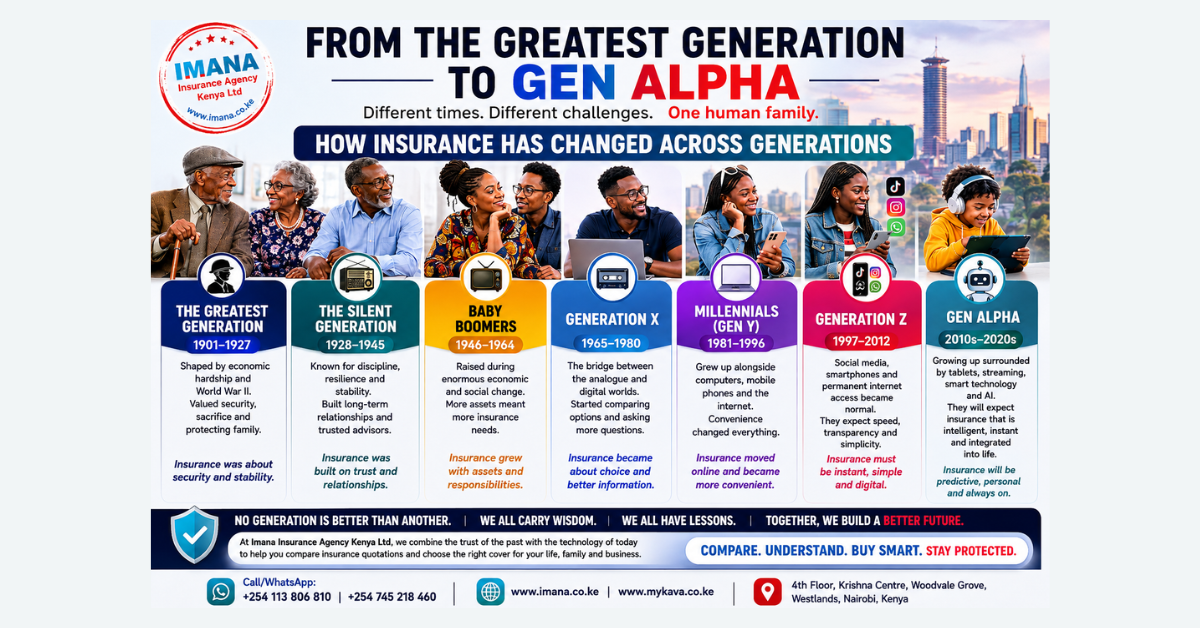
Understanding how insurance has changed from the Greatest Generation through the Silent Generation, Baby Boomers, Generation X, Millennials, Generation Z and Generation Alpha gives us a useful picture of where the insurance industry in Kenya is going.
Generational boundaries are not exact and different researchers use slightly different dates. Pew Research Center, for example, places the Silent Generation at 1928–1945, Baby Boomers at 1946–1964 and Generation X at 1965–1980, while definitions of younger generations vary between researchers. McCrindle defines Generation Alpha as those born between 2010 and 2024.
The bigger story, however, is not the dates.
It is how expectations changed.
1. The Greatest Generation: Insurance Was About Security
The Greatest Generation generally refers to people born in the early decades of the twentieth century, many of whom experienced economic depression, global war and enormous social disruption.
Their attitude towards money tended to emphasize security, saving, family responsibility and avoiding unnecessary financial risk.
Insurance therefore fitted naturally into the idea of protecting what a family had worked hard to build.
The insurance relationship was largely personal.
You knew your insurance agent or broker. Documents were physical. Policies were explained face-to-face. Premiums were paid through traditional banking or cash-based systems.
There was little concept of instantly comparing ten insurance quotations.
Trust came from people and institutions, rather than technology.
2. The Silent Generation: Relationships Built Insurance Businesses
For the Silent Generation, insurance remained highly relationship-driven.
An insurance intermediary was not merely somewhere you bought a policy. The intermediary could become a long-term adviser to a family or business.
Customers valued stability.
People might remain with the same insurance company, insurance broker or agent for decades.
Insurance documents were kept carefully in files. Renewals were handled manually. Claims involved physical documents, letters, telephone calls and office visits.
For this generation, convenience mattered, but reputation mattered more.
An insurer needed to look established, reliable and financially stable.
That principle has not disappeared.
Even today's digital customer wants speed, but when a serious claim happens, reputation and human support suddenly become extremely important.
3. Baby Boomers: Insurance Expanded With Growing Assets
As economies expanded and home ownership, vehicle ownership, employment and business activity increased, insurance expanded alongside them.
Baby Boomers increasingly needed protection for several areas of life.
Motor insurance became important as private vehicle ownership expanded. Medical insurance became more relevant as healthcare costs increased. Property, life, business and retirement-related financial products became more common.
The insurance customer was becoming more sophisticated.
However, buying insurance was still largely an offline activity.
You called an insurance company.
You visited an insurance office.
You spoke to an insurance agent.
You completed forms.
Then you waited for documentation.
Speed was measured in days rather than minutes.
4. Generation X: The Customer Started Asking More Questions
Generation X entered adulthood during major technological and economic changes.
Computers entered offices. Mobile phones became common. Email began replacing letters. Financial services became more competitive.
And insurance customers started asking a very important question:
“What else is available?”
The idea of comparison became increasingly important.
Instead of accepting the first insurance product presented to them, customers became more willing to consider different insurers, premiums, limits and policy conditions.
The intermediary therefore began changing from simply being the person who sold insurance into someone who could help the customer navigate different insurance options.
This shift remains highly relevant today.
It is the foundation of the modern insurance comparison model.
5. Millennials: Convenience Changed Insurance
Millennials grew into adulthood alongside the internet, smartphones, social media, online banking and digital commerce.
Their relationship with businesses became different.
A customer who could book a hotel online, order food from a phone and transfer money instantly naturally began wondering:
Why should buying insurance require several office visits?
That question changed insurance.
Websites became important.
Insurance quotation forms moved online.
Customers started researching insurers before making enquiries.
Email documents became normal.
Social media became part of customer service.
In Kenya, M-Pesa transformed the payment environment even further.
The modern insurance intermediary could now serve a customer whom they had never physically met.
Insurance had started moving from an office-based transaction to a digital service.
6. Generation Z: Insurance Must Now Compete With the Experience of Every Other App
Generation Z has pushed this transformation further.
This generation does not compare an insurance agency only with another insurance agency.
They compare the experience with everything else they do digitally.
If banking takes seconds, shopping takes minutes and communication happens instantly, insurance cannot comfortably operate as though the customer has nowhere else to go.
Gen Z customers increasingly expect simplicity.
They want understandable language rather than complicated insurance jargon.
They want fast responses.
They want to communicate through channels they already use.
They want pricing transparency.
They want choices.
And importantly, they often want to compare before committing.
This creates both a challenge and an enormous opportunity for insurance intermediaries.
The traditional sales approach was:
“Here is the insurance product we are selling.”
The emerging approach is:
“Tell us what you need, let us compare suitable options, and then you decide.”
That is a major philosophical change.
Kenya Has Become an Ideal Environment for Digital Insurance
Kenya's digital infrastructure makes this transformation particularly important.
The Communications Authority of Kenya reported in June 2026 that smartphones represented 63.7% of mobile phones connected to Kenyan networks. Mobile broadband accounted for 84.4% of internet connections during the reported quarter. Active mobile-money subscriptions had also reached approximately 53.4 million.
That changes what an insurance customer considers “convenient.”
A Kenyan customer sitting in Westlands, Kisumu, Eldoret, Mombasa, Nakuru or even outside the country may no longer see a physical visit to an insurance office as the natural first step.
The smartphone has effectively become an insurance branch.
This is especially important for motor insurance, medical insurance, travel insurance, WIBA insurance, COMESA Yellow Card insurance and other relatively straightforward insurance enquiries.
The digital customer wants to begin the conversation immediately.
7. Generation Alpha: The Insurance Customer Who Has Never Known an Offline World
Generation Alpha takes the transformation even further.
McCrindle defines Generation Alpha as people born between 2010 and 2024 and describes them as the first generation entirely born in the twenty-first century, shaped from childhood by screens and digital technology.
Most members of Gen Alpha are currently too young to be independent insurance buyers.
But insurance companies should be paying attention to them now.
Why?
Because when this generation begins buying cars, travelling independently, starting businesses, employing people and purchasing medical insurance, their idea of “digital” may be completely different from ours.
For Millennials, buying insurance through WhatsApp feels convenient.
For Generation Alpha, simply using WhatsApp may eventually feel old-fashioned.
They may expect insurance systems that already understand their needs, provide instant comparisons, explain complicated policies conversationally, allow immediate payment, show claims progress live and recommend protection according to changing circumstances.
Insurance will increasingly move from selling policies to managing risks continuously.
The Biggest Change Across Generations: From Selling Insurance to Solving Problems
This may be the most important lesson from all seven generations.
The product did not disappear.
Comprehensive motor insurance is still comprehensive motor insurance.
Third-party insurance still performs its legal and financial function.
Medical insurance still protects against eligible healthcare expenses.
WIBA still protects employers and employees against workplace-related risks according to applicable policy and legal provisions.
But the customer journey surrounding those products has completely changed.
Yesterday:
“Which insurance company should I visit?”
Today:
“Which insurer gives me the best combination of price, benefits and terms?”
Tomorrow:
“Why can't the system simply understand my risk and show me the best options instantly?”
That is where insurance is heading.
So, Is Imana Insurance Agency Serving the Needs of Today's Generation?
Yes — in several important areas, Imana is already operating in the direction modern insurance customers expect.
But there is also another side to that answer.
The journey cannot stop.
Imana's Comparison Model Fits the Modern Customer
One of the strongest changes in consumer behaviour is the demand for choice.
A customer does not necessarily want to hear:
“This is our insurance product.”
They increasingly want to ask:
“What are my options?”
Imana Insurance Agency Kenya Ltd works as an insurance intermediary partnering with multiple insurers, allowing customers to compare insurance quotations rather than being restricted to one insurance company's offering.
Imana's own online motor insurance information emphasizes comparison between insurers, while its motor quotation platform collects customer and vehicle information digitally before providing insurance options. (Imana)
That model is particularly compatible with Millennials and Gen Z.
Instead of loyalty being demanded before the customer understands the options, trust can be earned by helping the customer compare them.
WhatsApp Insurance Fits the Kenyan Digital Lifestyle
The WhatsApp insurance model is another strong fit.
Imana already promotes buying comprehensive and third-party motor insurance through WhatsApp, including comparing quotations and receiving digital insurance certificates. (Imana)
This is more significant than simply changing the communication channel.
WhatsApp effectively removes geography from the initial insurance transaction.
A customer does not necessarily have to travel across Nairobi, find parking, sit in an office and complete several forms before discovering the cost of insurance.
The conversation can begin wherever the customer is.
That is precisely the direction modern financial services are moving.
Online Insurance Quotations Match Millennial and Gen Z Expectations
Imana's website currently provides online quotation pathways covering areas including motor insurance, health insurance, micro insurance, life insurance, corporate insurance and last-expense insurance. (Imana)
That matters because younger consumers generally want to research before speaking to someone.
The website is no longer just an online company brochure.
It should increasingly become a decision-making platform.
The strongest insurance agencies of the future will allow customers to understand, compare, purchase, manage and claim through the same digital ecosystem.
M-Pesa Makes Digital Insurance Truly Kenyan
Digital insurance in Kenya cannot simply copy systems developed for markets where credit cards dominate.
Kenya has its own digital financial behaviour.
Mobile money is deeply embedded in everyday commerce, and Imana already incorporates M-Pesa payment into its insurance purchasing processes. (Imana)
That matters enormously.
Digital transformation works best when technology adapts to customers rather than forcing customers to adapt to technology.
Imana Also Maintains Something Younger Generations Still Need: Human Support
There is a danger in assuming younger customers want everything automated.
They usually want simple things automated.
But when something becomes complicated, they want competent human assistance.
A motor accident is different from ordering lunch online.
A rejected medical claim is different from cancelling an entertainment subscription.
A WIBA claim following an employee accident requires expertise.
A complicated comprehensive motor claim may require communication between the insured, insurer, assessor, garage and other parties.
That means the insurance agency of the future should combine two things that sometimes appear contradictory:
technology when the customer wants speed and people when the customer needs judgment.
Imana's model includes claims management and human insurance support alongside its digital quotation process. (Imana)
That hybrid model may actually be more powerful than trying to automate everything.
Where Imana Must Go Next
Being digitally advanced today does not guarantee being digitally advanced tomorrow.
The expectations of Gen Z and eventually Gen Alpha will continue moving.
The next phase should increasingly make insurance feel less like paperwork and more like a modern financial platform.
A customer should eventually be able to compare quotations faster, understand differences between policies visually, retrieve previous policies easily, receive renewal alerts, track claims, manage several insurance covers from one account and communicate seamlessly with an insurance expert when necessary.
Artificial intelligence will also change insurance education.
Instead of expecting a first-time customer to understand phrases such as excess, deductible, indemnity, territorial limits, PVT, excess protector, passenger legal liability or pre-existing conditions, insurance platforms will increasingly need to explain these concepts instantly in ordinary language.
That could be particularly powerful in Kenya, where increasing insurance penetration depends not only on affordability but also on making insurance easier to understand.
Gen Z Does Not Want Cheap Insurance. It Wants Value It Can Understand.
This distinction is important.
Digital customers are sometimes described as people who simply want the lowest price.
That can be misleading.
The cheapest insurance policy can become very expensive when a customer discovers after an accident that the protection they assumed they had was never included.
Comparison therefore needs to go beyond premium.
Customers should be able to compare:
price, benefits, exclusions, excesses, limits, insurer reputation, claims experience and additional benefits.
That is where a professional insurance intermediary remains relevant even when technology becomes more sophisticated.
Technology can produce options.
Expertise helps interpret them.
What Will Insurance Look Like for Gen Alpha?
The future insurance customer may not think in terms of annual insurance shopping.
Insurance could become increasingly embedded into everyday transactions.
Buying a vehicle could trigger appropriate insurance options immediately.
Booking a flight could trigger suitable travel insurance.
Starting a business could trigger recommendations for WIBA, public liability, professional indemnity, cyber insurance and other relevant covers.
Changing vehicles could automatically trigger a review of motor insurance.
Starting a family could trigger a review of medical and life insurance.
Insurance therefore becomes less about asking:
“Would you like to buy a policy?”
and more about asking:
“What changed in your life, and what new risk came with it?”
That is a much more intelligent insurance model.
Insurance Has Changed Because People Have Changed
From the Greatest Generation to Generation Alpha, each generation has inherited the same human problem:
Life is uncertain.
What changed is how people expect businesses to help them manage that uncertainty.
The Greatest Generation valued security.
The Silent Generation valued relationships.
Baby Boomers accumulated assets that required protection.
Generation X demanded more choice.
Millennials demanded convenience.
Generation Z demands speed, transparency and digital access.
Generation Alpha is likely to expect intelligence, personalization and near-instant service as the default.
The winning insurance businesses will not choose between the old world and the new one.
They will take the trust and professionalism of traditional insurance and combine them with the speed, transparency and convenience of digital technology.
Is Imana Ready for the Next Generation of Insurance?
Imana Insurance Agency Kenya Ltd has already moved beyond the purely traditional insurance-agency model.
Customers can compare insurance quotations, request quotes online, communicate through WhatsApp, use M-Pesa and access digital insurance services across products such as motor insurance, health insurance, travel insurance, WIBA insurance and other personal and business covers. (Imana)
That makes the model particularly relevant to today's Millennial and Gen Z insurance customers.
But becoming a truly Gen Alpha-ready insurance business will require continual evolution.
The future belongs to insurance intermediaries that can become faster without becoming careless, digital without becoming impersonal, automated without becoming confusing, and competitive without reducing insurance to price alone.
That is the opportunity before Imana.
Not merely to sell insurance to a new generation.
But to reinvent how that generation experiences insurance.
Frequently Asked Questions About Generations and Insurance in Kenya
How has insurance changed over the generations?
Insurance has moved from a predominantly face-to-face, paper-based industry toward a digital service where customers can research products, compare insurance quotations, communicate remotely, make mobile payments and receive insurance documents electronically.
What does Gen Z expect from insurance companies in Kenya?
Gen Z customers are likely to place greater emphasis on convenience, transparent information, mobile communication, quick responses, online comparisons and simple explanations of insurance products.
Can you buy insurance online in Kenya?
Yes. Increasingly, Kenyan insurance intermediaries and insurers allow customers to request quotations and complete significant parts of the insurance purchasing process remotely. Imana Insurance Agency, for example, provides online quotation forms and WhatsApp-based insurance assistance. (Imana)
Why should customers compare insurance quotations in Kenya?
Insurance premiums are only one part of an insurance policy. Different insurers can offer different terms, limits, excesses and additional benefits. Comparing insurance quotations can therefore help customers identify a policy that provides an appropriate balance between cost and protection.
Is Imana Insurance Agency suitable for digital insurance customers?
Imana's online quotation systems, multi-insurer comparison model, WhatsApp service, digital documentation, M-Pesa payment options and human insurance support make it strongly aligned with the needs of digitally connected insurance customers in Kenya. (Imana)
Will Gen Alpha change insurance?
Very likely. As Gen Alpha reaches adulthood, expectations around artificial intelligence, personalization, instant digital service and integrated financial products are likely to increase. Insurance providers will need to make insurance increasingly simple, responsive and connected to everyday life.
Compare Insurance Quotations in Kenya
Insurance has changed.
The customer has changed.
And choosing insurance should change too.
Before renewing your motor insurance, buying medical insurance, arranging travel cover or protecting your business, compare the available options.
Imana Insurance Agency Kenya Ltd helps individuals, families and businesses compare insurance quotations from trusted insurance companies and choose cover according to their needs, budget and risk profile.
Compare. Understand. Buy smart. Stay protected.