- Author: Raymond
- Category: Electric Vehicles Insurance
Electric Vehicle Insurance Kenya | Compare EV Insurance Quotes
Compare electric vehicle insurance in Kenya for EV cars, hybrids, vans, buses, motorcycles and charging equipment. Understand battery protection, towing, documents and claims before buying.
Electric Vehicles Need More Than Ordinary Motor Insurance
Electric vehicles are steadily becoming part of Kenya’s transport landscape.
Private motorists, public transport operators, delivery businesses and corporate fleets are increasingly considering electric cars, motorcycles, vans and buses. However, an electric vehicle has a different risk profile from a conventional petrol or diesel vehicle.
The battery pack, electric motor system, specialised electronics, charging cable and home charging equipment can represent a substantial part of the vehicle’s value. Repair capacity may also be limited to specialised technicians and approved service centres.
That is why electric vehicle insurance in Kenya should be selected carefully.
A suitable EV policy should provide standard motor protection while clearly addressing the expensive components and practical risks associated with electric mobility.
Kenyan insurers currently offering publicly advertised EV-specific products include Britam General Insurance, Pioneer Assurance and GA Insurance. Their benefits differ, so motorists should compare the actual quotation and policy wording instead of assuming every EV policy offers the same protection.
What Is Electric Vehicle Insurance?
Electric vehicle insurance is motor insurance structured to protect fully electric or hybrid vehicles while accounting for risks that may not be addressed clearly under a conventional motor policy.
Like ordinary motor insurance, an EV policy may provide protection against:
- Accidental damage
- Fire
- Theft
- Malicious damage
- Third-party bodily injury
- Third-party property damage
- Passenger liability, where applicable
- Towing and recovery expenses
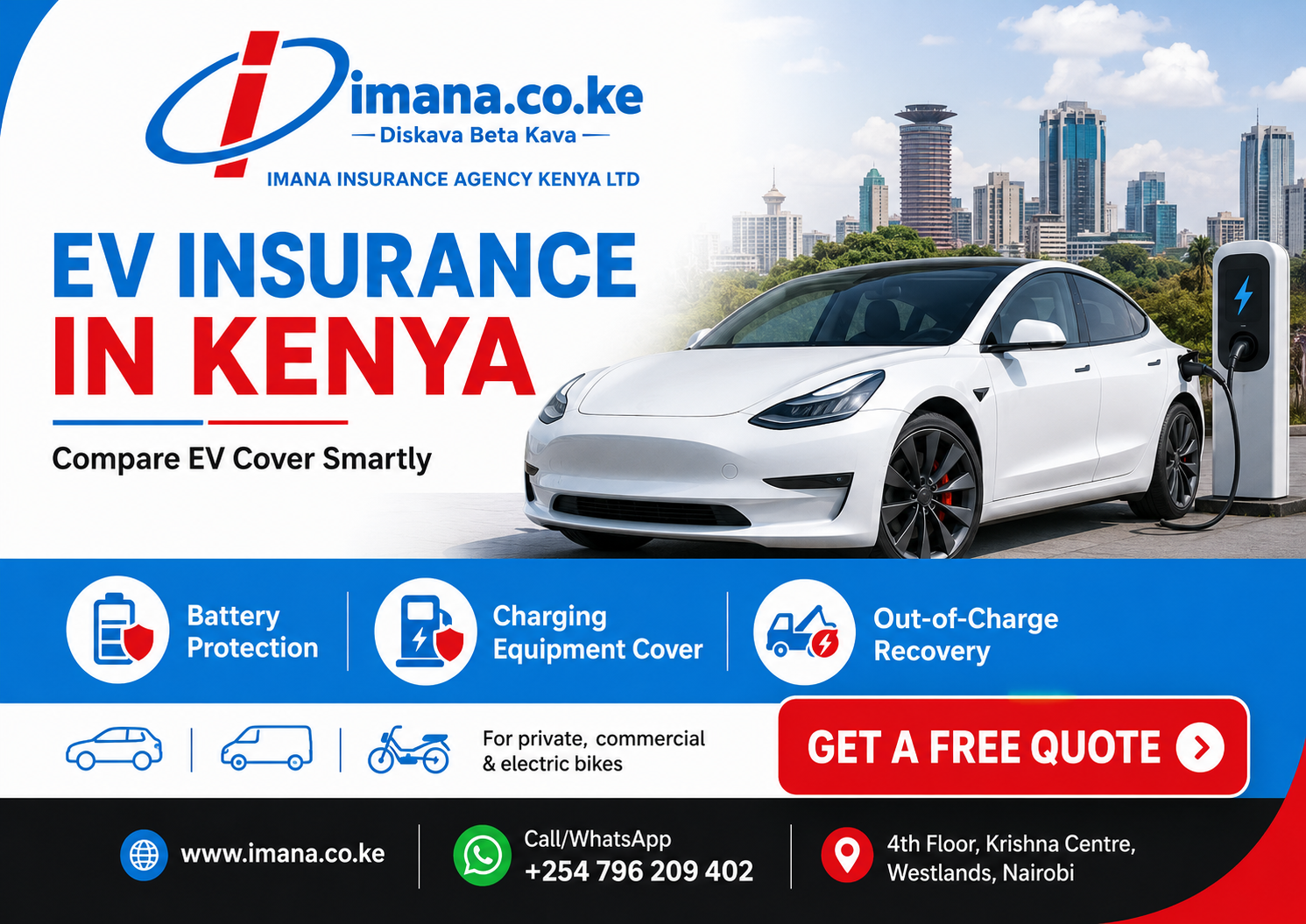
Specialised EV policies may then add protection for the battery, electric motor, charging cable, personal charging station and out-of-charge recovery.
Pioneer’s EVCare product, for example, publicly lists accidental damage, theft, fire, malicious damage and third-party liability alongside battery and charging-accessory protection. GA’s EV product includes the vehicle, battery, charging cable, third-party liability, passenger liability, accident medical expenses and flatbed towing.
Is EV Insurance Compulsory in Kenya?
Electric vehicles are still motor vehicles for insurance purposes.
Kenya’s Insurance (Motor Vehicle Third Party Risks) Act requires vehicles used on public roads to carry insurance against specified third-party risks, subject to the Act’s provisions and limited exceptions. (Kenya Law)
Third-party-only insurance generally protects the policyholder against covered liabilities involving other people. It does not ordinarily pay for accidental damage to the insured vehicle itself.
For an EV owner, this distinction is critical.
A third-party policy may satisfy the basic legal requirement, but it will not normally pay to repair your own battery, electric motor, charging cable or bodywork after an accident.
Owners of high-value electric cars, buses, vans and motorcycles should therefore consider comprehensive EV insurance.
What Does Comprehensive EV Insurance Cover?
The exact benefits depend on the insurer and selected extensions. The following are the principal areas to examine.
Battery and Electric Motor Protection
The lithium-ion battery is one of the most valuable components of an electric vehicle.
Britam’s EV insurance includes a Battery Protect extension intended to safeguard the battery and electric motor system. Pioneer states that its EVCare policy protects the battery and essential charging accessories, while GA covers loss or damage to the battery under its EV product.
Before selecting a quotation, ask:
- Is the battery covered after collision damage?
- Is theft of the battery covered?
- Is water or flood damage covered?
- Does the policy pay for repair or replacement?
- Is depreciation applied?
- Is there a separate battery excess?
- Must repairs be completed by an approved EV specialist?
- Does the insurer recognise the manufacturer’s warranty?
- Is the battery covered for its full replacement value?
Do not assume that battery ageing, gradual loss of capacity or a manufacturer defect is automatically insured. The public product summaries mainly describe protection against insured loss or accidental damage. Battery degradation and warranty-related problems should be confirmed separately in writing.
Electric Motor and Powertrain Cover
An EV does not have a conventional combustion engine, but it still contains an expensive motor, inverter, electronic control units and power-management systems.
Some specialised products specifically include the electric motor system. Britam identifies both the battery and electric motor within its EV protection framework.
Customers should ask whether the quotation covers:
- Collision damage to the electric motor
- Damage to the inverter
- High-voltage electrical components
- Power-control systems
- Cooling systems associated with the battery
- Damage caused by an insured external event
Mechanical or electrical breakdown cover should not be assumed unless it is expressly stated.
Charging Cable and Accessories
Charging cables are specialised vehicle accessories and can be expensive to replace.
GA’s EV policy includes charging cables among the covered accessories, while Pioneer lists protection for essential charging accessories.
Confirm whether the policy covers the cable:
- While stored inside the vehicle
- While connected to a charger
- At home
- Following theft
- Following accidental damage
- When using a public charging point
Ask whether a separate limit or excess applies.
Home Charging Station Cover
Some EV owners install a wallbox or private charging station at home or at their business premises.
Britam lists personal charging equipment among its EV benefits. GA offers private charging-station protection as an extension.
Before adding this benefit, confirm:
- The maximum insured value
- Whether installation costs are included
- Whether the charger is covered against theft
- Whether electrical damage is covered
- Whether accidental impact is covered
- Whether the installation must be performed by an approved technician
- Whether the charger is insured under the motor policy or property policy
Commercial charging stations may require separate engineering, property, liability or cyber insurance rather than being added to one vehicle’s policy.
Out-of-Charge Recovery
Running out of charge is the EV equivalent of running out of fuel—but ordinary tow services may not automatically provide the right recovery arrangement.
Britam includes an out-of-charge recovery service that transports a stranded EV to the nearest charging station. GA also lists out-of-charge recovery and flatbed towing, while Pioneer provides an emergency-support allowance for towing, recovery and certain emergency medical expenses.
Confirm:
- The annual towing limit
- The maximum distance
- The number of recoveries allowed
- Whether assistance operates nationwide
- Whether the benefit applies outside normal working hours
- Whether cross-border recovery is available
- Which telephone number should be called during an emergency
Out-of-charge recovery does not automatically mean the insurer will replace a faulty or degraded battery. It is primarily a roadside recovery benefit.
Third-Party and Passenger Liability
EV insurance should still address liabilities arising from injury, death or property damage involving other people.
GA publicly lists third-party and passenger liabilities under its EV cover. Pioneer also includes third-party death, injury and property-damage liability in EVCare.
Passenger liability is especially important for:
- Electric buses
- Electric taxis
- Ride-hailing vehicles
- Electric motorcycles carrying passengers
- Staff transport vehicles
- School transport
- Tour vehicles
The vehicle must be insured under the correct usage class. A privately insured EV should not be used commercially without notifying the insurer.
Optional EV Insurance Extensions
Some extensions are not automatically included in every EV policy.
Depending on the insurer, available additions may include:
- Political violence and terrorism
- Excess protector
- Loss-of-use cover
- Personal accident
- Personal-effects cover
- Alternative accommodation
- Autonomous-driving cover
- Cyber protection
- Increased third-party property-damage limits
GA lists autonomous-driving, cyber, loss-of-use, political-violence-and-terrorism, personal-accident and excess-protector extensions among the options under its EV product. These benefits should be treated as product-specific rather than standard across the market.
Electric Vehicle Insurance Providers in Kenya
Britam Electric Vehicle Insurance
Britam General Insurance launched its EV insurance cover in August 2025 for fully electric and hybrid vehicles.
Its publicly stated features include:
- Battery and electric motor protection
- Personal charging-equipment cover
- Out-of-charge recovery
- Transport to the nearest charging station
- Protection designed around EV repair and battery risks
The final benefits, excesses and premium depend on the quotation and policy documents issued to the customer.
Pioneer Assurance EVCare
Pioneer EVCare is a comprehensive EV policy available for electric:
- Cars
- Motorcycles
- Buses
Its published benefits include accidental damage, theft, fire, malicious damage, third-party liability, battery and charging-accessory cover, plus up to KSh 50,000 for towing, recovery and emergency medical expenses.
Customers should confirm whether the KSh 50,000 operates as one combined annual benefit or through separate sublimits.
GA Eco Drive EV Cover
GA Insurance offers an EV policy for several vehicle types, including:
- Private cars
- Vans
- Private and public buses
- Motorcycles
- Electric bicycles
- Scooters
Its core benefits include loss or damage to the vehicle, battery, charging cable and accessories, together with third-party liabilities, passenger liabilities, accident medical expenses and flatbed towing.
Available extensions include private charging-station protection, autonomous-driving cover, cyber cover, loss of use, political violence and terrorism, personal accident and excess protector.
These are examples of EV-specific providers, not a declaration that one company is universally the best. Underwriting appetite, premiums and product terms can change.
How Much Does EV Insurance Cost in Kenya?
There is no universal EV insurance price.
The official product pages reviewed do not publish one standard premium applicable to every electric car, motorcycle, van or bus. The quotation is customised according to the vehicle and selected benefits.
The insurer may consider:
- Vehicle make and model
- Current market value
- Battery replacement value
- Vehicle age
- Private or commercial use
- Driver profile
- Previous claims
- Availability of replacement parts
- Availability of qualified repairers
- Charger and cable value
- Required extensions
- Selected excess
- Geographical area of operation
- Whether the vehicle is fully electric or hybrid
A cheap quotation should not be accepted before confirming how the battery and charging equipment are treated.
Documents Required for EV Insurance
The standard documents required may include:
- Completed motor proposal form
- Vehicle logbook or ownership document
- Valid motor valuation report
- National ID for an individual
- Certificate of incorporation for a company
- KRA PIN
- Details of the required cover
GA lists these documents as requirements for its EV policy.
Depending on the vehicle, the insurer may also request:
- Importation documents
- Purchase invoice
- Battery specifications
- Battery warranty
- Charger invoice
- Charging-station installation information
- Vehicle inspection
- Claims history
- Driver details
- Confirmation of vehicle use
Providing complete and accurate information helps prevent delays or disputes.
Why a Proper EV Valuation Matters
An ordinary valuation may focus mainly on the vehicle’s overall market value.
An EV valuation should also recognise that the battery can represent a significant portion of the vehicle’s replacement cost. Britam’s product announcement identifies the battery as the most valuable EV component, while GA requires a valuation report for electric cars, vans and buses.
The valuation should help confirm:
- Current market value
- Battery condition
- Battery replacement cost
- Vehicle specifications
- Installed charging accessories
- Pre-existing damage
- Recommended sum insured
Underinsuring the EV may affect claim settlement. Overinsuring it does not necessarily mean the insurer will pay more than the vehicle’s actual insured value at the time of loss.
What to Compare Between EV Insurance Quotations
Do not compare premiums in isolation.
Review:
Battery terms
Check the insured value, excess, depreciation and circumstances in which the battery can be replaced.
Charging-equipment limits
Confirm whether cables and home chargers are included automatically or offered as optional extensions.
Recovery benefits
Compare towing limits, distance, availability and out-of-charge assistance.
Repair network
Ask which garages or technicians are approved to handle high-voltage systems.
Parts availability
Confirm how the insurer handles parts that must be imported.
Excesses
Check the standard excess and any additional young-driver, theft, battery or special-perils excess.
Loss-of-use benefits
Businesses operating electric taxis, vans or buses should establish whether replacement transport or loss-of-use compensation is available.
Territorial limits
Confirm whether the vehicle is covered only in Kenya or whether cover can be extended across East Africa.
Optional perils
Do not assume flood, political violence, cyber incidents or autonomous-driving risks are automatically covered.
EV Insurance Claims Process in Kenya
When an accident, theft or insured loss occurs:
- Notify the insurer or insurance intermediary immediately.
- Follow the insurer’s emergency and recovery instructions.
- Report accidents or theft to the police where required.
- Obtain a police abstract or other requested police documentation.
- Take photographs of the vehicle and scene where safe.
- Do not dismantle the battery or high-voltage components without approval.
- Move the vehicle only through an approved recovery provider where possible.
- Submit the claim form and requested supporting documents.
- Allow the insurer to appoint an assessor.
- Use an approved EV repair facility unless written authority states otherwise.
EV owners should never attempt to inspect damaged high-voltage components personally. Battery and electrical-system assessment should be left to qualified technicians.
Verify the Insurer Before Paying
The Insurance Regulatory Authority maintains a current registry of insurers and intermediaries licensed to operate in Kenya.
Before paying, confirm that the underwriting insurance company and the intermediary arranging the policy appear in the relevant 2026 licensed-entities records. (Insurance Regulatory Authority)
You should also verify:
- The insurer named on the quotation
- Payment instructions
- Policy number
- Cover period
- Vehicle registration
- Cover class
- Sum insured
- Excesses
- Extensions
- Official receipt
Compare EV Insurance Quotes Through Imana
Imana Insurance Agency Kenya Ltd helps private motorists, businesses, fleet owners and electric-mobility operators compare motor insurance quotations from trusted insurers.
The comparison can examine:
- Annual premium
- Comprehensive benefits
- Battery protection
- Electric motor cover
- Charging-equipment protection
- Recovery and towing
- Repair requirements
- Excesses
- Optional extensions
- Claims support
- Payment options
Imana can assist with cover for:
- Private electric cars
- Hybrid cars
- Electric motorcycles
- Electric delivery bikes
- Electric taxis
- Commercial electric vans
- Electric buses
- Corporate EV fleets
Visit Imana Insurance Agency Kenya Ltd at 4th Floor, Krishna Centre, Woodvale Grove, Westlands, Nairobi.
Call or WhatsApp: +254 796 209 402
Your EV is different. Its insurance should understand the difference. Compare the policy—not just the premium.
Frequently Asked Questions
Can I insure an electric vehicle in Kenya?
Yes. Several Kenyan insurers currently advertise specialised insurance for electric vehicles, including cars, motorcycles, vans and buses.
Does EV insurance cover the battery?
Specialised comprehensive EV policies may cover the battery against insured accidental damage or theft. The circumstances, limit, excess and depreciation terms differ between insurers.
Is battery degradation covered?
Battery degradation should not be assumed to be covered. Ask the insurer to distinguish accidental battery damage from ageing, gradual deterioration and manufacturer-warranty issues.
Does EV insurance cover a home charger?
Some products cover personal charging equipment or offer private charging-station protection as an extension.
What happens when an EV runs out of charge?
Selected policies provide towing or recovery to the nearest active charging station, subject to distance, frequency and monetary limits.
Can electric motorcycles be insured?
Yes. Pioneer and GA publicly include electric motorcycles among their eligible vehicle types. GA also includes electric bicycles and scooters.
Can an electric bus or van be insured?
Yes. GA includes vans and buses, while Pioneer includes electric buses under EVCare.
Does third-party insurance cover my EV battery?
No. Third-party-only cover generally protects against covered liabilities involving other people and does not insure accidental damage to your own vehicle or battery.
Which is the best EV insurance company in Kenya?
There is no single provider that is best for every EV. Compare battery terms, charger protection, repair arrangements, towing, excesses and premium before choosing.
EV insurance benefits, limits, premiums, excesses, repair arrangements and claims remain subject to the selected insurer’s underwriting requirements, policy schedule and full policy wording. Product features may change, so obtain a current written quotation before purchasing cover.
Visit Imana Insurance Agency Kenya Ltd https://www.imana.co.ke/ for guidance and quotation purposes.