- Author: Raymond
- Category: Comprehensive Car Insurance in Kenya
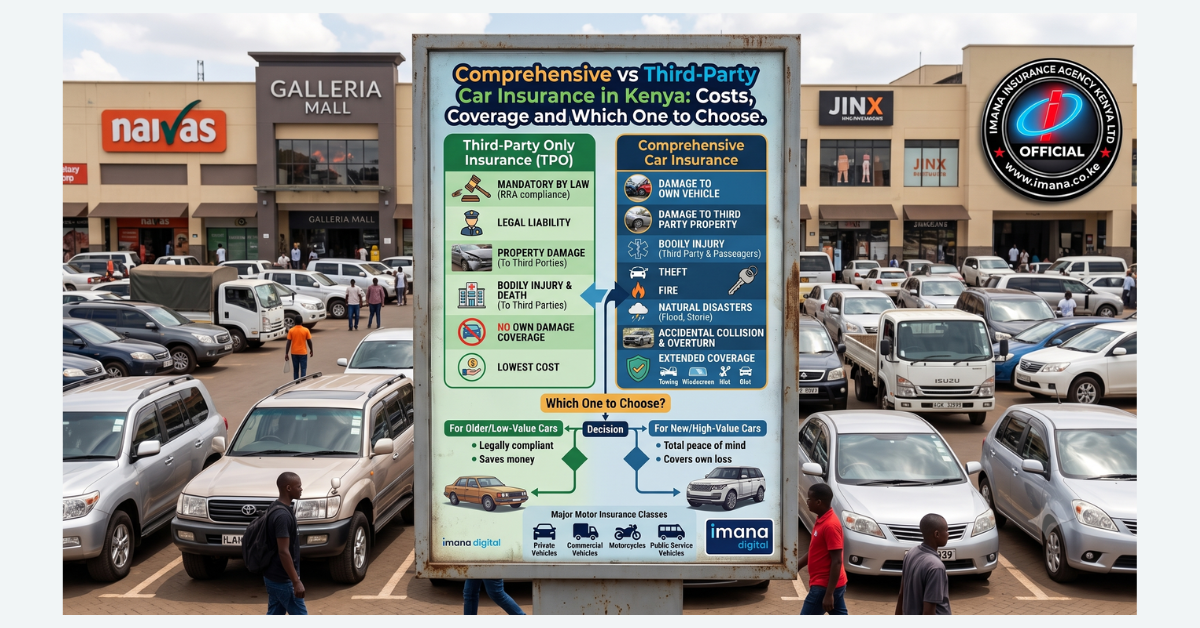
Comprehensive vs Third-Party Car Insurance in Kenya: Costs, Coverage and Which One to Choose
Compare comprehensive, Third-Party Only and Third-Party Fire and Theft car insurance in Kenya. Understand coverage, costs, valuation, benefits and exclusions before choosing.
Author: Raymond Momanyi, Founder and CEO, Imana Insurance Agency Kenya Ltd
Which Car Insurance Cover Is Right for You?
Choosing car insurance is not only about obtaining a certificate and complying with the law. It is a financial decision that determines whether you—or the insurer—will carry the cost when your vehicle is involved in an accident, stolen, damaged by fire or causes injury or damage to another person.
Kenyan motorists generally choose among three main types of cover:
- Third-Party Only Insurance
- Third-Party, Fire and Theft Insurance
- Comprehensive Car Insurance
The appropriate option depends on:
- Your vehicle’s current market value
- How the vehicle is used
- Whether it is financed
- Your ability to pay for repairs personally
- Your driving environment
- Your preferred level of protection
- Your insurance budget
Imana Insurance Agency Kenya Ltd helps motorists compare these options and obtain quotations from suitable insurers. Imana’s motor quotation form currently allows customers to request Comprehensive, Third-Party Only or Third-Party Fire and Theft cover. (Imana)
Quick links
- Learn about Motor Insurance in Kenya
- Explore Car Insurance Options
- Request a Motor Insurance Quote
- Report a Motor Insurance Claim
What Is Third-Party Car Insurance?
Third-Party Only Insurance, commonly called TPO, is the minimum compulsory motor-insurance protection required for most vehicles used on Kenyan roads.
Section 4 of Kenya’s Insurance (Motor Vehicles Third Party Risks) Act prohibits the use of a motor vehicle on a road unless an appropriate policy or security covering third-party risks is in force. (Kenya Law)
Third-Party Insurance is primarily designed to protect you against eligible legal liability involving other people.
Depending on the law and policy terms, it may respond to claims involving:
- Bodily injury to third parties
- Accidental death of third parties
- Damage to third-party property
- Passenger liability where applicable
- Legal expenses connected to an insured claim
What does “third party” mean?
In a motor-insurance contract:
- First party: The policyholder or insured vehicle owner
- Second party: The insurance company
- Third party: Another person who suffers injury, death or property damage involving the insured vehicle
Example
You accidentally collide with another vehicle.
Third-Party Insurance may consider eligible damage to the other vehicle and claims involving injured third parties.
However, it will not ordinarily pay to repair your own car.
What Third-Party Insurance Does Not Cover
Standard Third-Party Only Insurance generally does not cover:
- Accidental damage to your vehicle
- Theft of your vehicle
- Fire damage to your vehicle
- Flood damage to your vehicle
- Malicious damage
- Windscreen damage
- Towing or road-rescue expenses
- Loss of use
- Personal belongings inside the car
If your Third-Party-insured vehicle is badly damaged or written off, you may have to meet the repair or replacement cost personally.
Imana’s official Motor Insurance page describes Third-Party Only cover as the minimum legal option and distinguishes it from Comprehensive cover, which may include accidental damage, fire, theft, flood and third-party liability. (Imana)
Advantages of Third-Party Insurance
Lower initial premium
Third-Party Insurance is generally more affordable than Comprehensive cover because it does not insure accidental loss or damage to your own vehicle.
Legal compliance
It provides the minimum compulsory third-party protection required for most vehicles used on public roads.
Suitable for some low-value vehicles
It may be practical where:
- The vehicle has a low market value.
- Repair costs can be met personally.
- The cost of Comprehensive Insurance would be disproportionate to the vehicle’s value.
- The vehicle is rarely used.
Simple benefit structure
The focus is mainly on third-party legal liability rather than several own-damage benefits and extensions.
Disadvantages of Third-Party Insurance
The main limitation is that your own vehicle is not protected against accidental damage.
After an accident, you may still face:
- Repair costs
- Towing expenses
- Replacement costs
- Loss of income while the vehicle is unavailable
- Loan repayments on a damaged vehicle
- Alternative-transport expenses
A low premium can therefore create significant out-of-pocket exposure after a serious incident.
Third-Party Insurance protects you from certain claims made by others—but it does not protect the financial value of your own vehicle.
What Is Third-Party, Fire and Theft Insurance?
Third-Party, Fire and Theft, commonly abbreviated as TPFT, provides an intermediate level of protection.
It generally combines:
- Third-party bodily-injury liability
- Third-party property-damage liability
- Theft of the insured vehicle
- Fire damage to the insured vehicle
It usually does not cover ordinary accidental collision damage to your own vehicle.
Imana’s motor quotation system lists Third-Party, Fire and Theft as a separate option alongside Third-Party Only and Comprehensive Insurance. (Imana)
Who may consider TPFT?
This option may suit a motorist who:
- Wants more protection than basic Third-Party Insurance
- Is concerned about fire or theft
- Owns an older vehicle
- Does not want the cost of full Comprehensive Insurance
- Can manage ordinary accidental repair costs personally
Availability and terms differ among insurers, so a current written quotation is required.
What Is Comprehensive Car Insurance?
Comprehensive Car Insurance provides the widest standard level of motor protection.
Depending on the insurer, policy wording and selected extensions, it may cover:
- Accidental damage to your vehicle
- Collision damage
- Overturning
- Fire
- Theft
- Flood
- Falling objects
- Malicious damage
- Third-party bodily injury
- Third-party property damage
Imana’s official Motor Insurance and Car Insurance pages identify Comprehensive cover as the broadest option, providing own-vehicle protection together with third-party liability. (Imana)
The word “comprehensive” does not mean every possible event is covered. The policy still contains:
- Exclusions
- Excesses
- Driver conditions
- Territorial limits
- Security requirements
- Claims procedures
- Policy limits
Common Comprehensive Insurance Add-Ons
Optional extensions can improve the protection offered by the main policy.
Excess Protector
An excess is the portion of an eligible claim that the policyholder may have to contribute.
Excess Protector may cover selected accidental-damage excesses, but it may not remove every excess under the policy.
Special excesses may still apply to:
- Young drivers
- Inexperienced drivers
- Theft claims
- Total-loss claims
- Unauthorised drivers
- Certain vehicle classes
Political Violence and Terrorism
This extension may protect the insured vehicle against qualifying loss or damage resulting from:
- Political violence
- Riots
- Civil commotion
- Terrorism
- Specified malicious acts
Windscreen Cover
This may cover accidental damage to:
- Front windscreen
- Rear glass
- Side windows, where included
A separate annual limit may apply.
Road Rescue
Road-rescue services may include:
- Accident towing
- Breakdown assistance
- Battery jump-start
- Tyre assistance
- Emergency fuel delivery
Check the geographical radius and service limits.
Courtesy Car or Loss of Use
Some policies may provide a temporary replacement vehicle or a fixed benefit while the insured vehicle undergoes approved repairs.
This benefit is not automatically included in every Comprehensive policy.
Personal Accident
Personal Accident extensions may provide fixed benefits following accidental injury or death involving the insured driver or specified occupants.
COMESA Yellow Card
Motorists travelling across participating African countries may require a COMESA Yellow Card for recognised cross-border third-party protection.
A Yellow Card does not automatically extend Comprehensive own-damage cover outside Kenya. A territorial extension may also be required.
Comprehensive vs Third-Party Insurance: The Main Differences
Protection for your own vehicle
Third-Party Only:
Does not ordinarily cover damage to your vehicle.
Third-Party, Fire and Theft:
May cover theft and fire, but not ordinary accidental collision damage.
Comprehensive:
May cover accidental damage, theft, fire and other listed risks.
Third-party liability
All three options may provide third-party liability protection, subject to the law and policy terms.
Premium
Third-Party Only: Usually the lowest-cost option.
Third-Party, Fire and Theft: Generally costs more than TPO but less than Comprehensive cover.
Comprehensive: Usually attracts the highest premium because it protects both your vehicle and third parties.
Vehicle valuation
Third-Party Only: A full market-value assessment may not always be required.
Comprehensive: The vehicle usually needs an appropriate insured value, and the insurer may require a professional valuation.
Optional benefits
Comprehensive cover usually provides access to a wider range of extensions such as:
- Excess Protector
- Political Violence and Terrorism
- Windscreen
- Road rescue
- Courtesy vehicle
- Personal Accident
How Comprehensive Car Insurance Premiums Are Calculated
A Comprehensive premium is commonly influenced by:
- Vehicle market value
- Vehicle make and model
- Year of manufacture
- Vehicle use
- Driver details
- Claims history
- Security features
- Area of operation
- Selected extensions
- Policy excess
- Insurer’s minimum premium
The premium may be calculated as a percentage of the vehicle’s accepted value, subject to the insurer’s rating and minimum-premium requirements.
Two vehicles with the same value may still receive different premiums because their:
- Repair costs
- Theft exposure
- Spare-parts availability
- Claims history
- Intended use
may differ.
A private family car, online taxi and commercial delivery vehicle should not be quoted under the same risk class.
Why Vehicle Valuation Matters
A professional motor valuation helps establish the vehicle’s reasonable current market value.
It may also record:
- Make and model
- Registration number
- Year of manufacture
- Chassis and engine details
- Vehicle condition
- Existing damage
- Accessories
- Modifications
- Recommended insured value
Underinsurance
Underinsurance occurs when the vehicle is insured below its reasonable value.
This may result in:
- Inadequate total-loss compensation
- Application of the average condition
- Reduced settlement
- Difficulty replacing the vehicle
Overinsurance
Overinsurance occurs when the vehicle is insured above its reasonable value.
Insurance is intended to place the policyholder in approximately the financial position they occupied before the loss—not to create a profit.
An inflated sum insured therefore does not guarantee that the insurer will pay the inflated figure following a total loss.
What to Expect During Vehicle Valuation
1. Receive the approved valuer instructions
The insurer or insurance intermediary may provide a list of recognised motor-vehicle valuers.
2. Present the vehicle
The valuer may require:
- Vehicle logbook or eLogbook
- Owner’s identification
- Existing policy information
- Vehicle keys
- Details of modifications and accessories
3. Allow physical inspection
The valuer examines:
- Exterior condition
- Interior
- Engine and chassis details
- Mileage
- Tyres
- Accessories
- Existing damage
- General market condition
4. Receive or submit the report
The valuation report is sent to the insurer or intermediary for review.
5. Adjust the sum insured where necessary
Where the valuation differs from the amount proposed, the insurer may adjust:
- Sum insured
- Premium
- Policy terms
- Required security conditions
The policyholder should not ignore a valuation requirement. Failure to complete it within the stipulated period may affect the terms applying to a future claim.
When Third-Party Insurance May Be Suitable
Consider Third-Party Only cover where:
- The car has a relatively low market value.
- You can afford to repair or replace it personally.
- Comprehensive premiums are not economical compared with the car’s value.
- You mainly need minimum statutory third-party protection.
- The vehicle is rarely driven.
- You have accepted the financial risk of losing the vehicle.
However, driving rarely does not eliminate risks such as:
- Theft
- Fire
- Flood
- Damage while parked
- Accidents caused by another uninsured person
The lower premium should therefore be weighed against the possible loss.
When Comprehensive Insurance May Be Suitable
Comprehensive cover may be appropriate where:
- The vehicle is new or high-value.
- The car is financed by a bank or other lender.
- Repair costs would create financial hardship.
- The vehicle is essential for work or family transport.
- You drive frequently.
- You operate in congested or high-risk areas.
- Theft or flood exposure is a concern.
- You require optional benefits such as road rescue or Excess Protector.
Financiers commonly require Comprehensive Insurance because the vehicle is security for the loan.
Is Comprehensive Insurance Worth It for an Older Car?
Age alone should not determine the decision.
Consider:
- Current market value
- Mechanical condition
- Availability of spare parts
- Cost of repairs
- Annual premium
- Policy excess
- Minimum premium
- Personal ability to absorb a loss
An older but well-maintained and valuable vehicle may still justify Comprehensive cover.
Conversely, where the annual premium and likely excess represent a substantial proportion of the vehicle’s value, Third-Party or TPFT may be more practical.
Request quotations for all available options before deciding.
Common Mistakes Motorists Make
Choosing a policy based only on price
The cheapest option may have:
- Higher excesses
- Fewer extensions
- Restrictive driver conditions
- Lower limits
- Important exclusions
Insuring the vehicle under the wrong class
Examples include:
- Insuring an online taxi as a private car
- Insuring a commercial delivery vehicle as private
- Failing to declare tour or passenger use
- Failing to disclose business use
Using an outdated vehicle value
Vehicle values change over time. A previous valuation may no longer reflect the current market.
Failing to disclose modifications
Declare items such as:
- Custom bodywork
- Safari modifications
- Special rims
- Audio equipment
- Commercial equipment
- Tracking systems
Assuming Comprehensive covers everything
Comprehensive Insurance does not ordinarily pay for:
- Wear and tear
- Mechanical breakdown
- Gradual deterioration
- Driving without a valid licence
- Intoxicated driving
- Deliberate damage
- Unauthorised use
- Undeclared commercial use
Repairing before insurer approval
Except for reasonable emergency measures, do not begin major repairs before the insurer has inspected the vehicle or authorised the work.
Documents Required for a Car Insurance Quotation
Prepare:
- National ID or passport
- KRA PIN
- Vehicle logbook or eLogbook
- Registration number
- Make and model
- Year of manufacture
- Engine capacity
- Seating capacity
- Vehicle use
- Estimated market value
- Current insurance details
- Claims history
- Preferred cover type
For Comprehensive cover, a valuation may also be required.
Request a quotation through the Imana Motor Insurance Quote form. The form accommodates Comprehensive, Third-Party Only and Third-Party Fire and Theft enquiries. (Imana)
What to Do After an Accident
1. Confirm everyone is safe
Arrange emergency medical assistance where necessary.
2. Secure the accident scene
Use hazard lights and reflective triangles where safe.
3. Take photographs and videos
Capture:
- Vehicle positions
- Registration numbers
- Damage
- Road conditions
- Traffic signs
- Third-party property
- Surrounding area
4. Exchange information
Collect:
- Driver’s name
- Telephone number
- Vehicle registration
- Insurance details
- Witness contacts
5. Report to the police
Obtain the relevant police report or abstract.
6. Notify Imana or the insurer
Report the accident immediately and request the correct claim-document checklist.
7. Do not admit liability
Provide factual information, but do not privately promise compensation or accept legal responsibility before the matter is assessed.
8. Avoid unauthorised repairs
Allow the insurer to appoint an assessor and approve repairs where required.
Claims can be initiated through Imana’s online claims-request page.
Frequently Asked Questions
Is Third-Party Insurance compulsory in Kenya?
Most motor vehicles used on Kenyan roads must maintain insurance covering the third-party risks required by the Insurance (Motor Vehicles Third Party Risks) Act. (Kenya Law)
Does Third-Party Insurance cover damage to my car?
No. Standard Third-Party Only cover does not ordinarily pay for accidental damage to your own vehicle.
Does Third-Party Insurance cover theft?
No. Theft generally requires Third-Party Fire and Theft or Comprehensive Insurance.
Can I upgrade from Third-Party to Comprehensive?
Yes, subject to insurer approval. You may need:
- A vehicle valuation
- Photographs or inspection
- Additional premium
- Updated proposal information
Can I downgrade from Comprehensive to Third-Party?
Yes, usually at renewal. Consider the financial exposure before reducing your protection.
Does Comprehensive Insurance cover floods?
Flood damage may be included under many Comprehensive policies, but the exact terms, exclusions and excess should be confirmed from the quotation and policy wording. Imana lists flood among the risks that may be covered under its Comprehensive motor offering. (Imana)
Does Comprehensive Insurance cover mechanical breakdown?
Not ordinarily. Mechanical or electrical breakdown, wear and tear and gradual deterioration are commonly excluded unless a separate product applies.
Is vehicle valuation compulsory?
It depends on the insurer and vehicle. Comprehensive insurers commonly require valuation to confirm the appropriate sum insured and vehicle condition.
Can an old car obtain Comprehensive Insurance?
Possibly. Acceptance depends on:
- Vehicle age
- Condition
- Market value
- Availability of parts
- Inspection
- Insurer underwriting rules
What is an insurance excess?
It is the portion of an eligible claim that the policyholder may be required to contribute.
Is Excess Protector automatically included?
No. It is usually an optional benefit and may not remove every applicable excess.
Can Imana compare quotations from several insurers?
Yes. Imana’s motor service is designed to help customers compare available options, select suitable cover and request digital certificate processing. (Imana)
Which Cover Should You Choose?
There is no single correct answer for every motorist.
Choose Third-Party Only Insurance where:
- Affordability is the priority.
- The vehicle has a low value.
- You can meet your own repair or replacement costs.
- You understand that your vehicle is not protected.
Consider Third-Party, Fire and Theft where:
- You want third-party protection.
- Theft and fire are important concerns.
- Full Comprehensive cover is not economical.
Choose Comprehensive Insurance where:
- The car is valuable or financed.
- You need protection against accidental damage, theft and fire.
- Repair or replacement costs would cause financial pressure.
- You want access to broader optional benefits.
The best policy is not simply the cheapest. It is the policy that protects you against losses you cannot comfortably pay for yourself.
Compare Car Insurance Quotations with Imana
Imana Insurance Agency Kenya Ltd helps motorists compare:
- Third-Party Only Insurance
- Third-Party, Fire and Theft
- Comprehensive Insurance
- Private Motor Insurance
- Commercial Motor Insurance
- PSV and Online Taxi Insurance
- Motorcycle Insurance
- Tour and Safari Vehicle Insurance
- Fleet Insurance
- COMESA Yellow Card
Useful Imana Motor Insurance links
- Motor Insurance in Kenya
- Car Insurance in Kenya
- Get a Motor Insurance Quote
- PSV and Passenger Vehicle Insurance
- Motorcycle Insurance
- Report an Insurance Claim
- Visit the Imana Insurance Homepage
Contact Imana Insurance Agency Kenya Ltd
Office: 4th Floor, Krishna Centre, Woodvale Grove, Westlands, Nairobi
Call/WhatsApp: +254 796 209 402 | +254 745 218 460
Websites: www.imana.co.ke | www.mykava.co.ke
Compare the cover. Understand the exclusions. Protect your vehicle with confidence.
Motor-insurance premiums, benefits, excesses, vehicle-age limits, valuation requirements, extensions and exclusions vary among insurers. Obtain a current written quotation, policy schedule and complete policy wording before purchasing cover.