- Author: Raymond
- Category: Medical Insurance in Kenya
Compare Medical Insurance Quotes in Kenya | Corporate, Family & Individual Cover
Compare medical insurance quotes in Kenya for individuals, children, families and parents. Learn what different budgets can buy, what benefits to compare and how Imana helps you choose suitable cover.
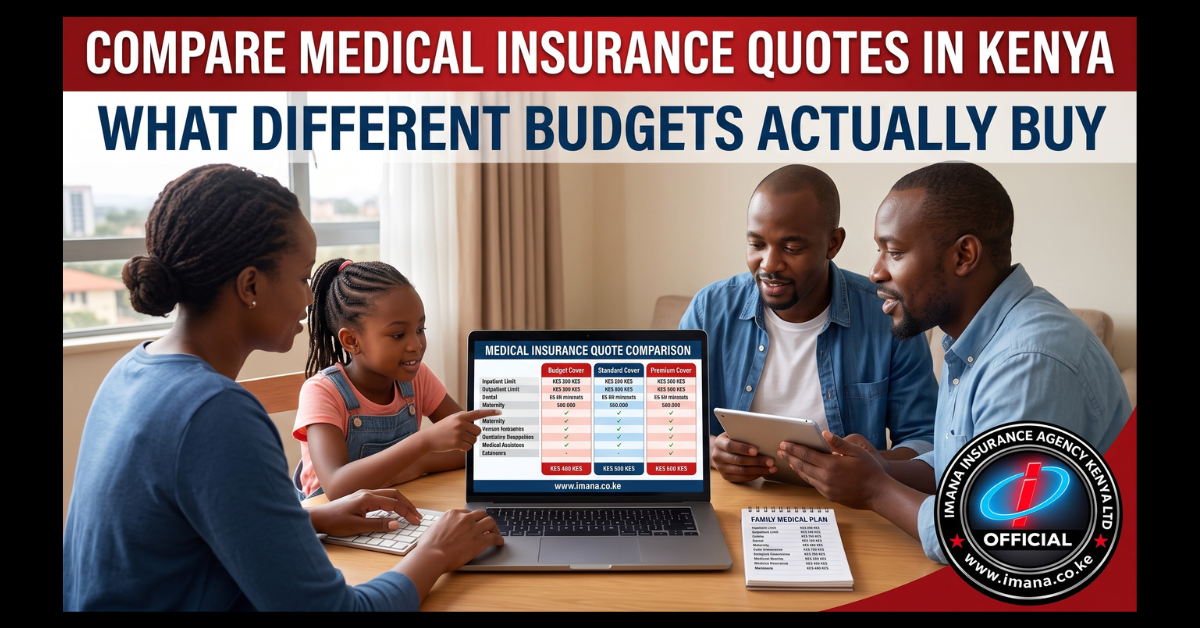
How much should medical insurance cost in Kenya?
The answer depends on another question:
Who are you trying to insure, and what level of protection do you actually need?
A single 28-year-old professional may need something completely different from:
- A couple with two children
- A parent looking for child-only medical insurance
- A family of five
- Someone covering elderly parents
- A small-business owner purchasing family cover
- An expatriate looking for wider geographical protection
That is why asking:
“How much is medical insurance?”
is only the beginning.
The better question is:
“What medical insurance options can I compare within my budget, and what am I giving up or gaining at each price level?”
At Imana Insurance Agency Kenya Ltd, we help individuals and families compare medical insurance quotations from different insurers, understand the benefits and limitations, and choose cover based on needs rather than price alone.
Medical Insurance Is Not a One-Size-Fits-All Product
Two medical insurance policies can both advertise:
KSh 500,000 inpatient cover
but still be very different.
One may offer a wider hospital network.
Another may provide better outpatient benefits.
Another may have stronger maternity benefits.
Another may provide dental and optical cover.
Another may have more restrictive waiting periods.
Another may have different terms for chronic or pre-existing conditions.
That is why comparing only the inpatient limit can be misleading.
You need to compare the whole package.
What Determines the Cost of Medical Insurance in Kenya?
Several factors can influence the premium you receive.
These may include:
- Age
- Number of people being insured
- Inpatient limit
- Outpatient limit
- Maternity benefits
- Dental cover
- Optical cover
- Chronic illness benefits
- Pre-existing-condition terms
- Geographical area of cover
- Hospital network
- Optional benefits
- Family structure
- Insurer underwriting requirements
The same budget can therefore produce very different options depending on the client.
Start With Your Budget — But Don't End There
Budget matters.
There is nothing wrong with saying:
“I can afford KSh 20,000.”
or:
“My family budget is around KSh 60,000.”
That information is useful.
The mistake is choosing a medical policy only because it fits the budget.
The right process should be:
Budget → Needs → Benefits → Limitations → Comparison → Decision
Not:
Budget → Cheapest quote → Pay.
What Can a Lower Medical Insurance Budget Buy?
A lower budget does not necessarily mean you cannot obtain meaningful medical protection.
It may simply mean prioritising the most important risks.
For example, a client on a tight budget may decide that the greatest concern is a major hospital admission.
In that case, the focus may be:
Inpatient Cover
Protection for hospitalisation arising from covered illnesses, accidents, surgery and other insured medical events.
The client may then keep:
- Outpatient cover lower
- Dental optional
- Optical optional
- Maternity excluded where unnecessary
- Geographical cover more limited
This can help control premium.
The important thing is understanding what has been left out.
What Can a Mid-Range Medical Budget Buy?
As the budget increases, clients can usually start balancing both major and everyday medical expenses.
Depending on the available insurer options, a mid-range policy may allow a combination of:
- Higher inpatient limits
- Outpatient cover
- Dental benefits
- Optical benefits
- Wider hospital access
- Enhanced specialist benefits
- Additional family benefits
This can be attractive to families because outpatient medical expenses are often more frequent than major hospital admissions.
Children, for example, may require:
- Doctor consultations
- Laboratory tests
- Medication
- Specialist visits
- Minor procedures
A policy should therefore reflect how the family actually uses healthcare.
What Does a Higher Medical Insurance Budget Buy?
Higher premiums do not simply buy bigger numbers.
They can potentially provide broader flexibility.
Depending on the insurer and product selected, higher-tier options may include:
- Higher inpatient limits
- Higher outpatient limits
- Wider hospital networks
- Wider geographical coverage
- Improved maternity benefits
- Enhanced dental benefits
- Enhanced optical benefits
- Specialist treatment benefits
- Better international treatment options
- Medical evacuation or related benefits
- Additional chronic-condition support
The value of these benefits depends on the client.
Someone who rarely travels outside Kenya may not need expensive worldwide medical cover.
Someone who travels frequently for business may consider it very important.
The best policy is not necessarily the biggest policy.
It is the one that best matches the risk.
Scenario 1: Medical Insurance for a Single Adult
Suppose you are a young working professional looking for medical insurance.
Your biggest priorities may be:
- Hospitalisation
- Doctor visits
- Laboratory tests
- Medication
- Emergency treatment
- Specialist consultations
You may not need:
- Maternity
- Large family benefits
- Child-related cover
This means your medical policy can be structured differently from that of a family.
Before buying, compare:
Inpatient limit
Outpatient limit
Hospital network
Waiting periods
Chronic-condition terms
Dental
Optical
Emergency benefits
A single adult should not automatically purchase the same package designed for a family of four.
Scenario 2: Medical Insurance for a Parent and Child
This is another common requirement.
A parent may want cover for themselves and one child.
The priorities can be different.
Children may require frequent outpatient treatment while the parent's biggest concern may be hospitalisation.
So when comparing quotations, ask:
- Is the child eligible under the policy?
- Can the child be covered without both parents?
- What outpatient limit applies?
- What paediatric services are available?
- Are vaccinations covered?
- What waiting periods apply?
- Which hospitals are available near home and school?
This is why child and family medical quotations should be compared carefully rather than selected from a generic price list.
Scenario 3: Child-Only Medical Insurance
Some parents specifically want to insure a child.
This may happen where:
- The parent already has employer medical cover
- The employer scheme does not cover dependants
- The child lives with another parent or guardian
- A separate medical policy is preferred
Not every medical product is structured the same way.
Where child-only medical cover is available, the important comparison points include:
- Minimum entry age
- Inpatient limit
- Outpatient limit
- Hospital network
- Waiting periods
- Vaccination benefits
- Dental
- Optical
- Chronic-condition terms
The cheapest child-only quotation is not automatically the most practical if the preferred hospitals are outside the network.
Scenario 4: Medical Insurance for a Family of Four
Now consider:
Two adults + two children
This is where medical insurance comparison becomes much more important.
Small differences in individual premiums can become substantial when multiplied across the entire family.
A family should consider:
- Inpatient limits
- Outpatient limits
- Maternity
- Child healthcare
- Dental
- Optical
- Specialist treatment
- Chronic illness
- Hospital network
- Geographical coverage
The family also needs to decide whether everybody requires exactly the same level of cover.
Sometimes they do.
Sometimes a different structure may make better financial sense.
Scenario 5: Medical Insurance for Parents Above 60
Medical insurance for older parents requires particularly careful comparison.
Age can affect:
- Eligibility
- Premium
- Waiting periods
- Medical underwriting
- Pre-existing-condition terms
- Chronic-condition cover
- Entry age
- Renewal conditions
Do not start by asking only:
“Which insurer is cheapest for my parents?”
Start with:
“Which insurers will accept them, what will be covered, what limitations apply, and which hospitals can they access?”
This is where professional comparison is especially valuable.
A cheap policy that excludes the conditions most likely to require treatment may provide limited practical value.
Inpatient Cover: The First Number Most People Compare
The inpatient limit is usually the largest figure displayed on a medical insurance quotation.
For example:
KSh 100,000
KSh 300,000
KSh 500,000
KSh 1 million
or higher.
It generally relates to covered hospital treatment subject to policy terms.
Higher limits may provide greater protection against major medical events.
But do not stop there.
Ask:
- Is the limit per person or family?
- Are there sub-limits?
- What hospitals can I use?
- Are certain procedures limited?
- What exclusions apply?
A large headline limit can still contain important sub-limits.
Outpatient Cover: Often Where Families Feel the Difference
Outpatient cover can be extremely important because it relates to treatment where admission is not required.
This may include covered:
- Consultations
- Medication
- Laboratory tests
- Diagnostic procedures
- Specialist visits
Families with children may use outpatient services regularly.
That means an apparently generous medical policy can become frustrating if the outpatient limit is too low for the family's actual healthcare needs.
Compare the outpatient benefit carefully.
Don't Ignore the Hospital Network
Imagine buying medical insurance and later discovering that your preferred hospital is not available under your plan.
That can be frustrating.
Before purchasing, ask:
Which hospitals are in the network?
Then consider the hospitals closest to:
- Your home
- Your workplace
- Your children's school
- Your parents' home
For many people, a slightly higher premium may be worthwhile if it provides practical access to preferred facilities.
Dental and Optical Benefits
Dental and optical cover may be offered as:
- Included benefits
- Optional extensions
- Benefits with specific limits
- Benefits subject to waiting periods
Ask yourself whether you actually need them.
Someone who wears prescription glasses may value optical benefits considerably.
A family with children may consider dental cover important.
Another client may prefer to use the premium budget to increase inpatient protection instead.
There is no universal answer.
That is the purpose of comparison.
Maternity Cover Requires Careful Planning
Maternity benefits are particularly important because they may be subject to waiting periods and other policy conditions.
If you are planning a family, do not wait until pregnancy before checking the medical policy.
Compare:
- Maternity limit
- Waiting period
- Normal delivery
- Caesarean section
- Pregnancy complications
- Newborn benefits
- Hospital network
Medical insurance works best when purchased before the need becomes immediate.
Pre-Existing Conditions: Ask Before You Buy
This is one of the most important areas in medical insurance.
A pre-existing condition is generally a medical condition that existed before the commencement of the insurance, subject to the insurer's definition.
Different insurers and plans may handle such conditions differently.
There may be:
- Exclusions
- Waiting periods
- Limits
- Medical underwriting
- Additional conditions
- Acceptance subject to specific terms
Never assume.
Disclose relevant medical information accurately and ask for the terms to be explained before purchasing.
Chronic Conditions
Conditions requiring ongoing management can create significant healthcare costs.
These may include conditions such as:
- Diabetes
- Hypertension
- Asthma
- Other chronic illnesses
When comparing medical insurance, ask:
- Is chronic treatment covered?
- What limit applies?
- Does a waiting period apply?
- Are there disease-specific limits?
- Does the outpatient limit include chronic medication?
This matters much more than simply knowing the total annual premium.
Waiting Periods Can Change the Value of a Policy
A waiting period means certain benefits may not become available immediately after the policy starts.
Different benefits may have different waiting periods.
These can potentially apply to areas such as:
- Maternity
- Chronic conditions
- Pre-existing conditions
- Certain procedures
Before paying, ask:
“Which benefits are available immediately and which ones require me to wait?”
That question can prevent disappointment later.
Local, Regional or Worldwide Medical Cover?
Not everyone needs international medical insurance.
If you live and work primarily in Kenya, a local or regional plan may be sufficient depending on your needs.
But clients who:
- Travel frequently
- Work internationally
- Have children studying abroad
- Are expatriates
- Want access to overseas treatment
may need broader geographical coverage.
Wider geographical limits generally affect cost.
Pay for the geography you actually need.
Why Medical Insurance Quotes Differ Between Insurers
Two insurance companies can receive the same family information and return different quotations.
That is normal.
Insurers may differ in:
- Pricing
- Hospital networks
- Benefits
- Limits
- Underwriting appetite
- Entry ages
- Waiting periods
- Pre-existing-condition terms
- Chronic-condition benefits
- Optional extensions
This is exactly why medical insurance is well suited to comparison.
The Cheapest Medical Insurance May Not Be the Most Affordable
This sounds contradictory.
But consider this.
Policy A
Lower annual premium.
Very limited outpatient cover.
Narrow hospital network.
Policy B
Slightly higher annual premium.
Better outpatient benefit.
Preferred hospitals included.
If you frequently pay for consultations and medication outside Policy A's limits, the cheaper policy may eventually cost your household more.
True affordability means considering:
Premium + Benefits + Out-of-Pocket Costs.
Bigger Limits Are Not Automatically Better Either
The opposite mistake also happens.
Someone may purchase the highest available medical limits simply because they sound impressive.
But higher limits usually cost more.
If that premium becomes difficult to maintain, the policy may become financially unsustainable.
A good adviser should not always push you toward the highest-priced plan.
The better goal is:
Adequate protection at a sustainable premium.
Medical insurance should survive your budget for years, not months.
Should You Tell Imana Your Budget?
Yes.
It actually helps.
For example:
“I need cover for myself and two children and can spend around KSh X annually.”
That gives the adviser a starting point.
We can then investigate what different insurers and plans may offer around that budget.
Sometimes increasing the budget slightly can unlock significantly better benefits.
Other times, removing an unnecessary benefit can reduce the premium without materially weakening the cover.
That is where advice adds value.
What Information Does Imana Need for a Medical Insurance Quote?
You can normally start with basic information such as:
- Number of people to be covered
- Ages or dates of birth
- Relationship between applicants
- Preferred inpatient limit
- Whether outpatient cover is needed
- Whether maternity is needed
- Dental requirements
- Optical requirements
- Existing medical conditions where relevant
- Preferred hospitals
- Geographical coverage required
- Approximate budget
Additional information may be requested depending on the insurer and plan.
How Imana Helps You Compare Medical Insurance
Medical insurance comparison should not mean receiving ten PDFs and being left alone to figure them out.
At Imana, the process should be simpler.
Step 1: Tell Us Who You Want to Cover
Individual?
Child?
Couple?
Family?
Parents?
Employees?
Step 2: Tell Us Your Priorities
For example:
- Affordable premium
- Higher inpatient limit
- Strong outpatient cover
- Preferred hospital
- Maternity
- Chronic illness
- International cover
Step 3: Compare Available Options
We help identify suitable quotations from participating insurers based on the information provided.
Step 4: Understand the Differences
We help explain:
- Premium
- Inpatient
- Outpatient
- Hospital network
- Waiting periods
- Benefits
- Limits
- Important exclusions
Step 5: Choose and Purchase
You select the option that makes the most sense for your needs and budget.
Much of the communication and purchasing process can be handled digitally.
Why Use an Insurance Intermediary for Medical Insurance?
If you approach one insurer directly, that insurer can explain its own medical plans.
Nothing wrong with that.
But if you want to compare the market, an intermediary can make the process much easier.
Instead of asking:
“Is this insurer's medical policy good?”
we can ask:
“How does this option compare with other available policies for this particular client?”
That distinction matters.
Especially when you are buying insurance for an entire family.
Medical Insurance Needs Human Advice
Medical insurance can become technical very quickly.
A quotation may contain words such as:
- Sub-limit
- Co-pay
- Waiting period
- Pre-existing condition
- Chronic condition
- Exclusion
- Network provider
- Territorial limit
You should understand these terms before purchasing.
Digital insurance should make buying easier.
It should not mean removing human advice from the process.
At Imana, we believe technology should handle convenience while experienced people help clients make sense of the cover.
Already Have Medical Insurance? Compare Before Renewal
You don't need to be uninsured to compare medical quotations.
In fact, renewal is one of the best times to review your cover.
Ask:
- Did my premium increase?
- Has my family changed?
- Do I need maternity now?
- Are my preferred hospitals still available?
- Is my outpatient limit adequate?
- Have my parents grown into another age category?
- Can another insurer offer better value?
- Are there benefits I am paying for but rarely use?
Send your current medical policy or renewal terms to Imana and let us review the options.
Medical Insurance for Businesses and Employees
Medical insurance comparison is not limited to individuals.
Businesses can also compare group medical quotations for employees.
The comparison may consider:
- Number of employees
- Family structures
- Inpatient limits
- Outpatient limits
- Maternity
- Dental
- Optical
- Chronic conditions
- Hospital network
- Claims utilisation
- Existing scheme performance
For employers, the cheapest group medical quotation is not always the best long-term option.
Employee experience matters too.
Questions to Ask Before Buying Medical Insurance in Kenya
Before paying for medical insurance, ask:
- What is my inpatient limit?
- What is my outpatient limit?
- Which hospitals can I use?
- Does the policy have waiting periods?
- How are pre-existing conditions treated?
- Are chronic illnesses covered?
- Is maternity included?
- What dental benefit applies?
- What optical benefit applies?
- What geographical area is covered?
- Are there co-payments?
- Are there important sub-limits?
- What happens at renewal?
- Who helps me if I have a problem using the cover?
If you cannot answer these questions, get clarification before buying.
Frequently Asked Questions About Medical Insurance in Kenya
How much does medical insurance cost in Kenya?
There is no single price.
Cost depends on factors such as age, family size, benefits, inpatient and outpatient limits, hospital network, geographical coverage and the insurer selected.
The most accurate way to know your cost is to request quotations using your actual details.
Can I compare medical insurance companies in Kenya?
Yes.
An insurance intermediary can help you compare available quotations and benefits from different participating insurers.
Can I insure my child only?
Some medical insurance products allow child-only arrangements subject to eligibility requirements and policy terms.
The available options should be compared based on the child's age, benefits required and insurer conditions.
Can I buy medical insurance for my parents?
Yes, depending on the insurer's entry-age rules, underwriting requirements and available products.
Older applicants should compare eligibility, premiums, hospital networks, chronic-condition terms and other limitations carefully.
Can I buy medical insurance online?
Much of the quotation, comparison, document submission and purchasing process can be handled digitally, subject to the insurer's requirements.
Should I choose the cheapest medical insurance?
Not automatically.
Consider the premium alongside:
- Benefits
- Hospital network
- Limits
- Waiting periods
- Exclusions
- Chronic-condition terms
- Out-of-pocket expenses
Choose value, not price alone.
Don't Ask Only, “How Much?”
When buying medical insurance, the cheapest question is:
“How much?”
The better questions are:
What is covered?
Where can I receive treatment?
What limits apply?
What do I have to wait for?
What is excluded?
What happens if I develop a chronic condition?
Who helps me when I need to use the cover?
Those questions tell you whether the policy actually fits your life.
Compare Medical Insurance Quotes with Imana
At Imana Insurance Agency Kenya Ltd, we help individuals, families, parents and businesses compare medical insurance options based on their actual needs.
We combine:
Comparison
Different insurance options can be reviewed side by side.
Advice
We help explain the benefits, limits and important differences.
Digital Purchasing
Quotation requests and much of the purchasing process can be handled remotely.
Human Insurance Expertise
You still have access to people who can help explain your cover when the terminology gets complicated.
Ready to Compare Medical Insurance?
Tell us:
Who needs cover?
Their ages?
Your preferred benefits?
Your approximate budget?
Then let us help you compare suitable available options.
Medical Insurance:
https://imana.co.ke/insurance/health-insurance
Request a Quote:
https://imana.co.ke/micro-quote
Website:
https://www.imana.co.ke
Call/WhatsApp:
+254 796 209 402
Imana Insurance Agency Kenya Ltd
4th Floor, Krishna Centre
Woodvale Grove, Westlands
Nairobi, Kenya
Don't buy a medical policy because the price looks good. Buy it because the cover makes sense.
Compare. Understand. Choose with confidence.
Author: Raymond Momanyi - Founder and CEO Imana Insurance Agency Kenya Ltd (Unitas Digital)