- Author: Raymond
- Category: Corporate & SME Insurance in Kenya
Compare Corporate Insurance in Kenya | Medical, WIBA, CAR & Fleet
Compare corporate insurance in Kenya across Group Medical, WIBA, Liability, Contractors All Risk, Group Life, Stock, Professional Indemnity and Motor Fleet. Learn what businesses should compare before choosing cover.
Corporate Insurance:
https://imana.co.ke/insurance/corporate-insurance
Imana Insurance Agency Kenya Ltd:
www.imana.co.ke
MyKava:
www.mykava.co.ke
Corporate Insurance in Kenya Should Be Compared as a Risk Programme, Not a Collection of Policies
Corporate Insurance becomes more useful when a business stops asking:
“Which insurer has the cheapest quotation?”
and instead asks:
“Which combination of policies best protects our people, assets, liabilities, contracts and operations?”
An organisation may need several forms of insurance at the same time.
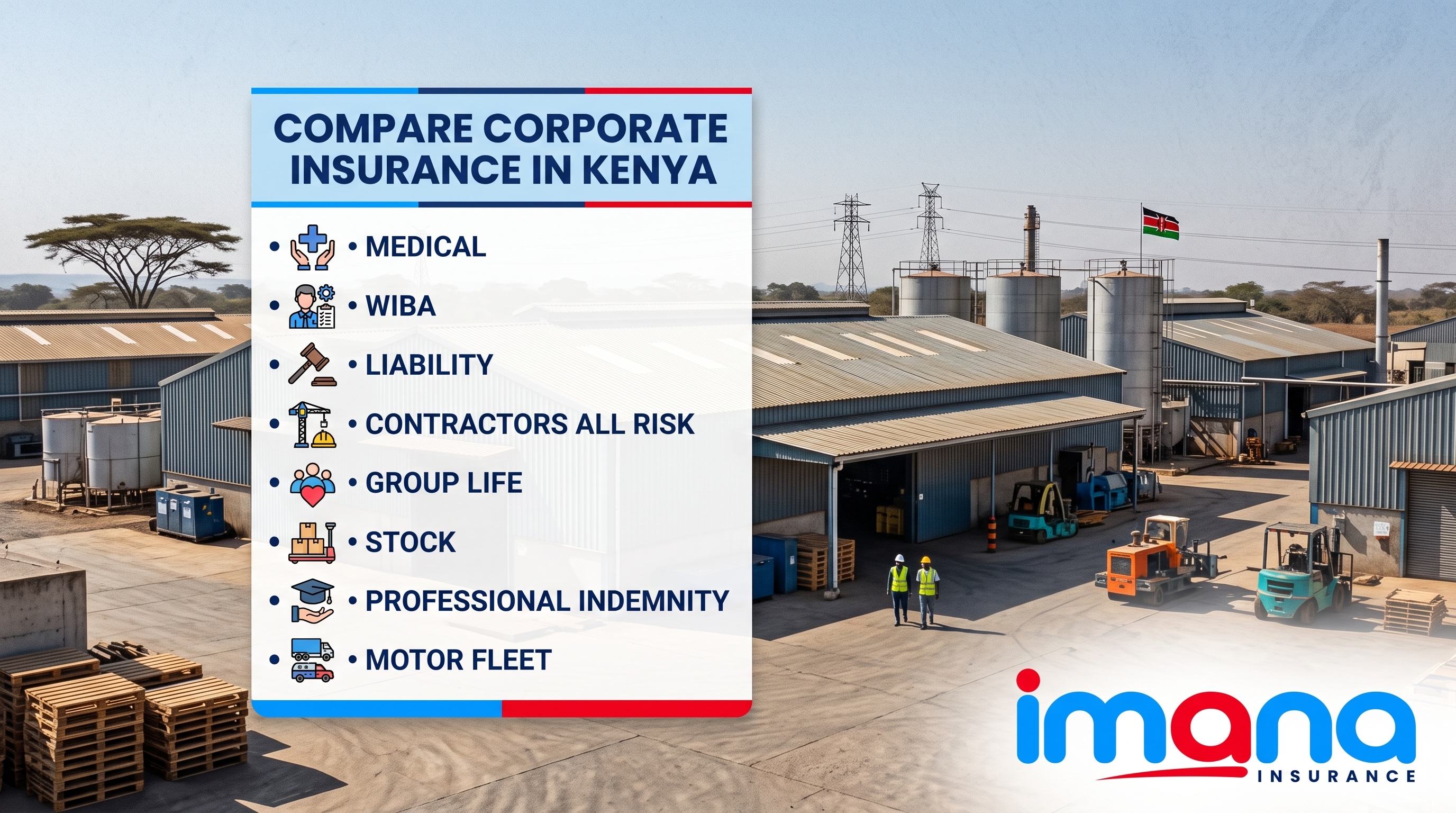
These can include:
- Group Medical Insurance
- WIBA
- Public and General Liability
- Contractors All Risk
- Group Life
- Stock Insurance
- Professional Indemnity
- Institutional Motor Fleet
Each protects a different exposure.
Imana Insurance Agency Kenya Ltd is one option. Based in Westlands, Nairobi, it helps individuals, families and businesses compare quotations across Motor, Medical, WIBA, PSV, Travel and other insurance classes before choosing cover.
For corporate clients, that comparison can extend across the wider business insurance portfolio.
What Does Corporate Insurance Comparison Mean?
Corporate insurance comparison is the process of presenting substantially the same risk information to suitable insurers and then comparing the resulting quotations on more than premium.
A meaningful comparison should consider:
- Scope of cover
- Sum insured or liability limit
- Sublimits
- Excess or deductible
- Exclusions
- Warranties
- Territorial limits
- Waiting periods where applicable
- Claims requirements
- Premium and payment terms
- Renewal conditions
The lowest quotation is not necessarily the strongest quotation.
Two insurers can charge similar premiums while providing materially different protection.
For example, quotations may differ on:
- Hospital networks
- Chronic-condition benefits
- Employee definitions
- Professional-services wording
- Stock valuation
- Motor vehicle use
- Liability limits
- Construction-project extensions
The correct comparison is therefore cover first, price second. This comparison approach is also emphasised in the supplied draft.
Use the Same Risk Information When Comparing Insurers
A business should avoid giving different information to different insurers.
For a fair comparison, prepare one consistent risk schedule.
Depending on the cover required, this may include:
- Nature of business
- Business locations
- Number of employees
- Payroll
- Employee occupations
- Asset values
- Stock values
- Vehicle schedule
- Vehicle use
- Project values
- Professional activities
- Claims history
- Current insurance schedule
This helps prevent a misleading situation where one insurer appears cheaper only because it was given a lower payroll, smaller stock value or incomplete vehicle schedule.
1. Compare Group Medical Insurance in Kenya
Group Medical Insurance provides healthcare benefits to employees and, depending on the scheme, eligible dependants.
Benefits may include:
- Inpatient treatment
- Outpatient treatment
- Maternity
- Dental
- Optical
- Chronic-condition benefits
- Cancer and renal benefits
- Last Expense
The exact structure varies by insurer.
What Businesses Should Compare
The employer should examine:
- Inpatient limit
- Outpatient limit
- Hospital panel
- Co-payments
- Maternity limits
- Dental and optical limits
- Chronic-condition limits
- Cancer and renal benefits
- Pre-existing-condition treatment
- Waiting periods
- Age restrictions
- Dependant eligibility
Do not compare Group Medical only on premium.
A lower-priced scheme can become less attractive if:
- Employees cannot access preferred hospitals
- Chronic benefits are heavily restricted
- Co-payments are high
- Important treatments have small sublimits
Group Medical Is Not WIBA
This distinction is essential.
Group Medical Insurance pays eligible healthcare expenses according to the medical policy.
WIBA addresses qualifying work-related injuries, occupational diseases and compensation liabilities.
One does not automatically replace the other.
A business may therefore need both.
2. Compare WIBA Insurance in Kenya
Under section 7 of Kenya's Work Injury Benefits Act, every employer is required to obtain and maintain insurance in respect of liability under the Act unless the employer qualifies for the statutory exemption supported by approved security. Failure to maintain the required insurance can result in a fine of up to KSh 100,000, imprisonment for up to three months, or both.
WIBA relates to qualifying injuries, occupational diseases or death arising out of and in the course of employment.
What to Compare in WIBA
Businesses should compare:
- Annual payroll
- Employee categories
- Occupational risk
- WIBA versus WIBA Plus
- Medical-expense provisions
- Claims requirements
- Occupational-disease wording
- Policy extensions
- Employee definitions
A professional office and a construction site should not ordinarily be treated as identical risks.
Employee categories may include:
- Office staff
- Drivers
- Technicians
- Warehouse employees
- Machine operators
- Construction workers
- Field employees
Correct classification matters.
How WIBA Compensation Works
The Work Injury Benefits Act contains statutory compensation mechanisms rather than a simple flat insurance benefit.
For permanent disablement, compensation is calculated using a statutory formula based on 96 months' earnings, adjusted according to the degree of disablement and applicable statutory minimums and maximums.
For temporary disablement, periodical payments can continue while the disablement persists, subject to the Act, but for no longer than 12 months.
Businesses should therefore avoid relying on oversimplified benefit summaries when comparing WIBA policies.
WIBA Plus and Group Personal Accident
Basic WIBA primarily relates to work-related exposure.
Some insurers offer enhanced arrangements commonly described as WIBA Plus, which may combine WIBA with broader Personal Accident benefits.
Depending on the insurer, these extensions may provide protection for accidents occurring outside normal working duties.
The exact wording varies.
Businesses should therefore ask:
- Is this standard WIBA?
- Is off-duty accident protection included?
- Is Group Personal Accident separate?
- What limits apply?
3. Compare Public and General Liability Insurance
Liability Insurance protects businesses against specified legal liabilities involving third parties.
It is not one single product.
Relevant corporate covers may include:
- Public Liability
- Product Liability
- Employers' Liability
- Contractual Liability extensions
Public Liability
Public Liability may respond to eligible claims for accidental third-party:
- Bodily injury
- Death
- Property damage
arising from insured business operations.
It can be particularly relevant for:
- Hotels
- Restaurants
- Shopping centres
- Schools
- Clinics
- Contractors
- Retailers
- Event venues
What to Compare
Check:
- Limit per occurrence
- Annual aggregate
- Territorial scope
- Jurisdiction
- Excess
- Products extension
- Completed-operations extension
- Tenant's liability
- Cross-liability wording
- Contractual-liability exclusions
Public Liability Is Not Professional Indemnity
A customer slipping in your office may create a Public Liability exposure.
A client losing money because of allegedly negligent professional advice may create a Professional Indemnity exposure.
They are fundamentally different risks.
Businesses should not assume that buying one automatically covers the other.
4. Compare Contractors All Risk Insurance
Contractors All Risk Insurance, commonly called CAR Insurance, is designed for construction projects.
It can protect:
- Permanent works
- Temporary works
- Materials
- Construction-related property
- Third-party liability
subject to the policy.
Who Typically Needs CAR?
It may be relevant to:
- Developers
- Main contractors
- Subcontractors
- Project owners
- Fit-out contractors
Construction contracts and lenders may also require evidence of CAR Insurance.
What to Compare
Review:
- Contract value
- Project duration
- Project location
- Type of works
- Third-party liability
- Existing structures
- Surrounding property
- Testing and commissioning
- Maintenance period
- Plant and machinery
- Flood
- Collapse
- Theft
- Political violence
- Named insured parties
The employer, contractor and relevant subcontractors should be identified correctly where required.
CAR Does Not Replace Other Insurance
Contractors All Risk should not be treated as a substitute for:
- WIBA
- Motor Insurance
- Professional Indemnity
- Contractors' Plant and Machinery
A construction business may need all of them.
5. Compare Group Life Insurance
Group Life provides a death benefit for insured employees according to the policy.
It may also include optional benefits such as:
- Permanent disability
- Critical illness
- Funeral benefits
Group Life is separate from:
- WIBA
- Medical Insurance
- Last Expense
What to Compare
Employers should review:
- Sum assured
- Flat benefit versus salary multiple
- Free Cover Limit
- Medical underwriting requirements
- Age limits
- Disability benefits
- Critical-illness riders
- Actively-at-work conditions
- Premium structure
- Claims requirements
Some schemes calculate benefits as a multiple of salary.
The appropriate structure depends on the employer's benefits strategy.
Group Life Does Not Replace WIBA
An employee may qualify for Group Life following death according to the policy.
A work-related death may also create obligations under WIBA.
These are separate arrangements.
One should not automatically be treated as a substitute for the other.
6. Compare Stock Insurance
For many businesses, stock represents a large portion of working capital.
A major fire, flood or theft can therefore threaten the survival of the business.
Stock may be insured against specified risks such as:
- Fire
- Special perils
- Burglary
- Theft
- Flood where included
depending on the policy.
What to Compare
Review:
- Sum insured
- Valuation basis
- Average stock level
- Peak stock
- Seasonal fluctuations
- Burglary conditions
- Storage warranties
- Alarm requirements
- Watchman requirements
- Goods held in trust
- Spoilage extensions
- Declaration-policy options
Underinsurance Is a Major Stock Risk
Suppose a business regularly carries KSh 20 million worth of stock but declares only KSh 10 million.
The premium may look attractive.
But after a major loss, the underinsurance can affect settlement where the policy's average condition applies.
The lesson is simple:
Do not lower the sum insured simply to lower the premium.
7. Compare Professional Indemnity Insurance
Professional Indemnity, commonly called PI Insurance, protects against certain liabilities arising from professional:
- Errors
- Omissions
- Negligence
- Breach of professional duty
It may be relevant to:
- Lawyers
- Accountants
- Architects
- Engineers
- Doctors
- Consultants
- Surveyors
- Technology firms
- Other professional practices
What to Compare
Pay particular attention to:
- Limit of indemnity
- Aggregate limit
- Excess
- Retroactive date
- Professional-services definition
- Defence costs
- Territorial limits
- Jurisdiction
- Claims-made wording
- Loss-of-documents extensions
- Libel and slander extensions
- Run-off cover
Why the Retroactive Date Matters
Most Professional Indemnity policies operate on a claims-made basis.
That means the timing of:
- The professional service
- The alleged error
- The claim
- The policy period
can matter significantly.
Businesses should therefore be cautious when moving between insurers.
A cheaper renewal quotation may not represent better protection if continuity or the retroactive date is weakened.
8. Compare Institutional Motor Fleet Insurance
Organisations operating several vehicles may benefit from a fleet arrangement.
Fleet insurance may apply to:
- Corporate cars
- Delivery vehicles
- School buses
- Ambulances
- NGO vehicles
- Institutional vehicles
- Commercial vehicles
Depending on the vehicle class, cover may include:
- Comprehensive
- Third Party Fire & Theft
- Third Party Only
Kenyan law requires qualifying vehicles used on public roads to have compliant third-party insurance or security.
Comprehensive cover, however, is a commercial choice rather than the statutory minimum.
What to Compare in Motor Fleet Insurance
Review:
- Vehicle schedule
- Market values
- Vehicle use
- Comprehensive rate
- Third Party premium
- Excess
- Driver restrictions
- Windscreen
- Political Violence and Terrorism
- Excess Protector
- Tracking requirements
- Anti-theft warranties
- Road rescue
- Courtesy vehicle
- Claims history
Correct vehicle use is especially important.
A company should distinguish between:
- Private corporate cars
- Commercial vehicles
- Institutional vehicles
- PSV vehicles
The law itself also recognises different certificate categories for fare-paying passenger vehicles, business vehicles, private cars and motorcycles.
Build Corporate Insurance Around Four Risk Areas
Rather than buying policies randomly, businesses can organise insurance around four broad risk areas.
People
Consider:
- Group Medical
- WIBA
- Group Personal Accident
- Group Life
Assets
Consider:
- Property
- Stock
- Machinery
- Electronic equipment
- Motor Fleet
Liability
Consider:
- Public Liability
- Product Liability
- Professional Indemnity
- Employers' Liability
Projects and Contracts
Consider:
- Contractors All Risk
- Contractors' Plant and Machinery
- Performance Bonds
- Marine Insurance
- Goods in Transit
This framework makes insurance gaps easier to identify.
Corporate Insurance for an Office-Based SME
An office-based SME may consider:
- WIBA
- Group Medical
- Public Liability
- Professional Indemnity where professional advice is provided
- Office contents
- Motor Insurance where vehicles are owned
The exact combination depends on operations.
Corporate Insurance for Contractors and Developers
A contractor may need:
- WIBA
- Contractors All Risk
- Contractors' Plant and Machinery
- Public Liability
- Professional Indemnity where design responsibility exists
- Commercial Motor
- Performance Bonds
The insurance programme should align with the construction contract.
Corporate Insurance for Traders and Distributors
A distributor may consider:
- Stock Insurance
- Fire and Special Perils
- Burglary
- Goods in Transit
- WIBA
- Public Liability
- Product Liability
- Commercial Motor Fleet
- Business Interruption
A company carrying large inventory should pay particular attention to stock valuation and supply-chain risks.
Corporate Insurance for Schools, NGOs and Institutions
Institutions may require:
- WIBA
- Group Medical
- Group Life
- Institutional Motor Fleet
- Property Insurance
- Public Liability
- Professional Indemnity where specialist services are offered
Schools may also need Student Personal Accident, which is separate from WIBA.
Corporate Insurance for Hospitals and Clinics
Healthcare organisations may have exposures involving:
- Employees
- Patients
- Professional liability
- Buildings
- Medical equipment
- Vehicles
Relevant covers can include:
- WIBA
- Group Medical
- Medical Professional Indemnity
- Public Liability
- Property Insurance
- Electronic Equipment
- Motor Fleet
How to Read a Corporate Insurance Quotation
Before accepting a corporate quotation, check the following carefully.
First, ensure the insured name matches the legal entity that actually owns or carries the risk.
Second, verify:
- Policy period
- Sums insured
- Liability limits
- Excesses
- Sublimits
Then review:
- Exclusions
- Warranties
- Territorial limits
- Claims notification conditions
Also verify important operational warranties such as:
- Alarm systems
- Tracking devices
- Driver-age conditions
- Watchmen
- Storage requirements
A quotation is not just a premium sheet.
It is a summary of the risk the insurer is prepared to accept.
Documents Commonly Required for Corporate Insurance Quotes
Depending on the class of business, an insurer or intermediary may request:
- Certificate of incorporation
- Company KRA PIN
- Payroll summary
- Employee schedule
- Asset schedule
- Stock declaration
- Vehicle schedule
- Logbooks
- Vehicle valuations
- Contracts
- Bills of quantities
- Professional registration details
- Fee-income information
- Claims history
- Existing insurance schedule
Preparing these in advance can speed up comparison.
Why Claims History Matters
Corporate insurers may consider previous losses when determining:
- Premium
- Excess
- Limits
- Conditions
- Whether to quote
An organisation with repeated preventable losses may eventually face:
- Higher premiums
- Higher excess
- Restrictive terms
Risk management therefore matters.
Insurance transfers financial risk; it does not replace safety, maintenance, controls or governance.
Why Compare Several Corporate Insurers?
Different insurers can have different underwriting appetites.
One insurer may be particularly competitive for:
- Group Medical
Another may have stronger terms for:
- Construction
Another may be more attractive for:
- Motor Fleet
- Professional Indemnity
- Property
That is why declaring one insurer the “best corporate insurer in Kenya” without considering the actual risk can be misleading.
The better question is:
Which insurer is offering the strongest combination of cover, terms and premium for this particular risk?
Why Use Imana Insurance Agency Kenya Ltd?
Corporate insurance comparisons can involve several classes at the same time.
Imana can help businesses:
- Identify key exposures
- Prepare underwriting information
- Obtain quotations
- Compare insurer terms
- Review limits
- Clarify exclusions
- Coordinate placement
- Support endorsements
- Assist with claims administration
The insurer remains responsible for underwriting and settling admissible claims.
The supplied draft similarly positions the intermediary's role as gathering risk details, obtaining quotations, explaining differences and supporting placement and claims administration—not replacing the insurer.
Corporate Insurance in Westlands, Nairobi
Imana Insurance Agency Kenya Ltd is based in Westlands, Nairobi and provides corporate insurance comparison support to organisations in Nairobi and across Kenya.
Corporate clients may include:
- SMEs
- Contractors
- NGOs
- Schools
- Hospitals
- Retailers
- Professional firms
- Manufacturers
- Logistics companies
- Corporate organisations
Corporate Insurance:
https://imana.co.ke/insurance/corporate-insurance
Frequently Asked Questions
What is Corporate Insurance?
Corporate Insurance is a broad term covering insurance products designed to protect organisations against risks involving employees, assets, liabilities, vehicles, contracts and operations.
Is WIBA compulsory in Kenya?
Section 7 of the Work Injury Benefits Act requires employers to maintain insurance for liability under the Act, subject to the statutory exemption mechanism.
Is Group Medical the same as WIBA?
No. Group Medical addresses eligible healthcare expenses under a health policy. WIBA addresses qualifying workplace injury, occupational disease and related statutory compensation.
Does Public Liability cover professional mistakes?
Not ordinarily. Professional negligence is generally addressed through Professional Indemnity Insurance.
Is Contractors All Risk compulsory?
Not generally in the same statutory sense as WIBA. However, construction contracts, financiers or project owners may require CAR Insurance contractually.
Can a company insure several vehicles together?
Yes. Organisations with multiple vehicles may qualify for fleet arrangements depending on insurer underwriting.
Does Group Life replace WIBA?
No. Group Life and WIBA address different benefits.
Can stock be insured?
Yes. Businesses may insure inventory against specified risks such as fire, burglary and other insured perils.
Does Imana compare Corporate Insurance quotations?
Yes. Imana can assist businesses in comparing available quotations across several corporate insurance classes.
Does Imana settle insurance claims?
No. The insurer determines admissibility and settles insured claims. Imana can assist the client with documentation, communication and follow-up.
Compare Corporate Insurance Before Renewal
Corporate renewal should not simply involve accepting last year's policy again.
Before renewal, review:
- Payroll
- Employee numbers
- New branches
- Vehicle additions
- Vehicle disposals
- Stock values
- New equipment
- Contract values
- Business activities
- Claims history
A business can change considerably in twelve months.
Its insurance programme should change with it.
Start Comparing Corporate Insurance Quotes in Kenya
Whether your organisation needs:
- Group Medical
- WIBA
- Public Liability
- Contractors All Risk
- Group Life
- Stock Insurance
- Professional Indemnity
- Institutional Motor Fleet
start by defining the risk accurately.
Then compare insurers on:
Coverage → Limits → Exclusions → Excess → Claims Terms → Premium
rather than premium alone.
Corporate Insurance:
https://imana.co.ke/insurance/corporate-insurance
Imana Insurance Agency Kenya Ltd:
www.imana.co.ke
MyKava:
www.mykava.co.ke
The Bottom Line
Corporate Insurance is not one product.
It is a portfolio of different protections covering:
People. Property. Liability. Vehicles. Projects. Contracts.
Group Medical does not replace WIBA.
Public Liability does not replace Professional Indemnity.
CAR does not replace employee or motor insurance.
Group Life does not replace work-injury compensation.
And a fleet policy cannot correct an inaccurately declared vehicle use.
The strongest corporate insurance programme starts by identifying the risk correctly and then comparing insurers using consistent information.
Imana Insurance Agency Kenya Ltd is one option. Based in Westlands, Nairobi, it helps individuals, families and businesses compare quotations across Motor, Medical, WIBA, PSV, Travel and other insurance classes before choosing cover.
Compare the risk. Compare the wording. Compare the insurer. Then compare the price.
Author:
Raymond Momanyi – Founder & CEO, Imana Insurance Agency Kenya Ltd
This article provides general information about corporate insurance in Kenya. Insurance availability, limits, premiums, exclusions and underwriting requirements vary by insurer. Always verify current insurer licensing and review the quotation, policy schedule and policy wording before purchasing cover.